Skip to content


BISCUITS AND CRUNCHY TREATS
BOL RED HEART SPANISH TREATS
BOL RED HEART SPANISH TREATS
By BARK OUT LOUD
Out of Stock
Couldn't load pickup availability
Check Availability
Rapid 3-4 Day Delivery,Tiny Extra Fee!
-
 Pet Safe
-
 Best Quality
-
 Fast Delivery
-
 Secure Payment


About Bark Out Loud Red Heart Treats
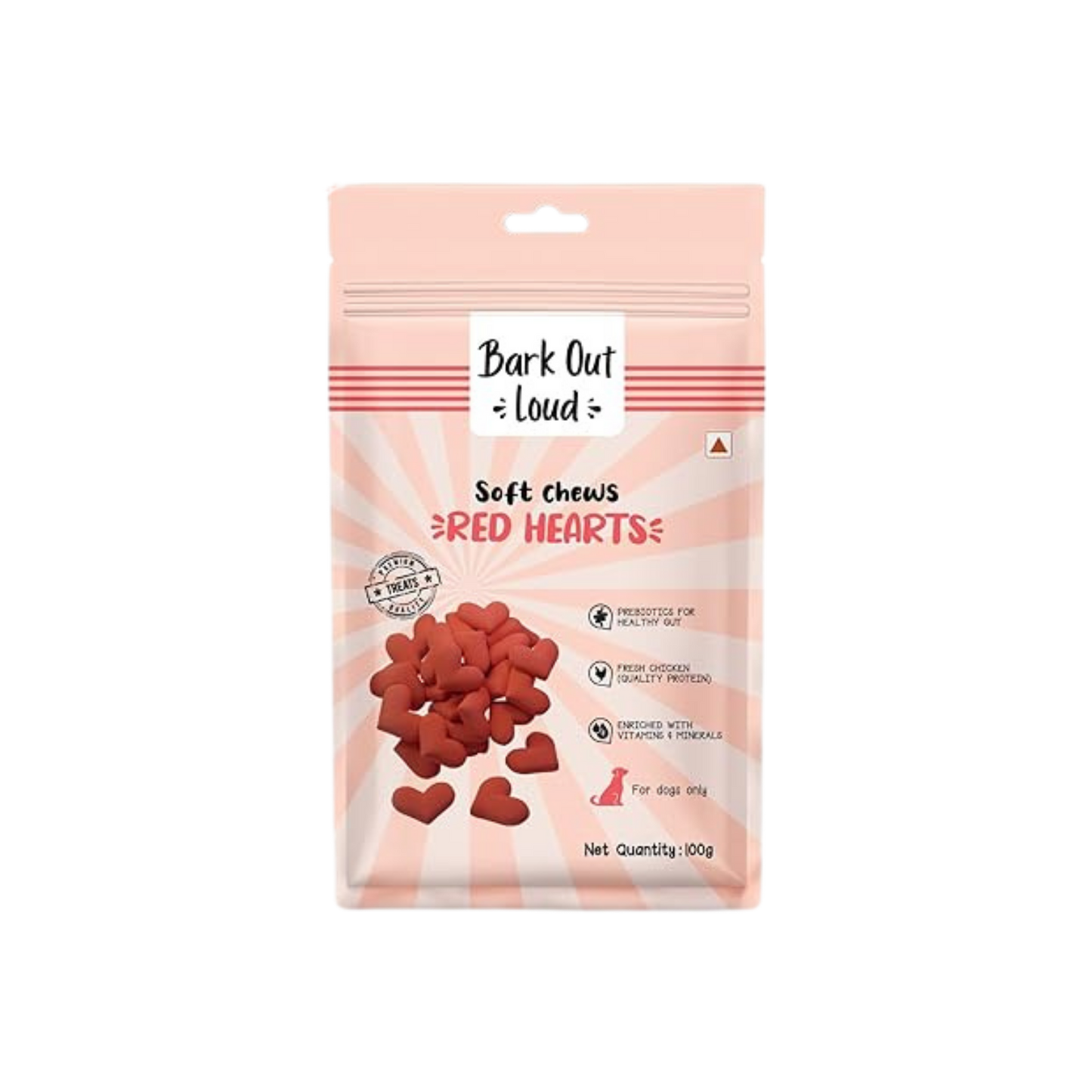
Dogs love variety in their rewards. Bark Out Loud Red Heart Treats are heart-shaped dog treats, in a 100g pack.
Give a piece at a time as a reward, or break it up for training.
Features and Benefits
- Everyday reward. Easy to portion for training or a quick treat.
How to Use
- How much. Treats should make up no more than about 10 percent of your pet's daily calories. The rest should come from a complete and balanced main food. Give less to small or less active dogs.
- Storage. After opening, fold the pack tightly or move the treats to an airtight jar, and keep them in a cool, dry place.
- Water. Keep fresh, clean drinking water available at all times.
Safety and Precautions
- Not a meal. This is a treat. Your dog still needs a complete and balanced main food.
- New treats. Introduce slowly. Stop and speak to your vet if your dog has vomiting, loose stools or itchy skin after trying it.
Also in: Dog Treats · All Dog Products
Product Information
| Detail | Information |
|---|---|
| Brand | Bark Out Loud |
| Made by | Vivaldis (Bark Out Loud range) |
| Net quantity | 100g |
| Suitable for | Dogs |
| Sold by | Goodman Vetcare Pvt. Ltd. (Animeal), Warehouse No - 501 5th floor, Bharat industrial estate, Tokershi Jivraj Rd, Sewree West, Sindhu Nagar, Sewri, Mumbai, Maharashtra 400015 |
Animeal shares this information to help you choose the right product for your pet. Product details are based on the brand's published information and the pack. If you have questions about your pet's health or diet, please speak to your vet.

BOL RED HEART SPANISH TREATS
Out of Stock
About Bark Out Loud Red Heart Treats
Dogs love variety in their rewards. Bark Out Loud Red Heart Treats are heart-shaped dog treats, in a 100g pack.
Give a piece at a time as a reward, or break it up for training.
Features and Benefits
- Everyday reward. Easy to portion for training or a quick treat.
How to Use
- How much. Treats should make up no more than about 10 percent of your pet's daily calories. The rest should come from a complete and balanced main food. Give less to small or less active dogs.
- Storage. After opening, fold the pack tightly or move the treats to an airtight jar, and keep them in a cool, dry place.
- Water. Keep fresh, clean drinking water available at all times.
Safety and Precautions
- Not a meal. This is a treat. Your dog still needs a complete and balanced main food.
- New treats. Introduce slowly. Stop and speak to your vet if your dog has vomiting, loose stools or itchy skin after trying it.
Also in: Dog Treats · All Dog Products
Product Information
| Detail | Information |
|---|---|
| Brand | Bark Out Loud |
| Made by | Vivaldis (Bark Out Loud range) |
| Net quantity | 100g |
| Suitable for | Dogs |
| Sold by | Goodman Vetcare Pvt. Ltd. (Animeal), Warehouse No - 501 5th floor, Bharat industrial estate, Tokershi Jivraj Rd, Sewree West, Sindhu Nagar, Sewri, Mumbai, Maharashtra 400015 |
Animeal shares this information to help you choose the right product for your pet. Product details are based on the brand's published information and the pack. If you have questions about your pet's health or diet, please speak to your vet.





About Bark Out Loud
Bark Out Loud Treats, Food and Easy Pill
Bark Out Loud is an Indian pet care brand from Vivaldis Health and Foods. Most people find it through one product: Easy Pill, the soft treat you wrap a tablet in so your pet swallows it without a fight. The rest of the range is treats, cat pillows, dental and coat sticks, and small trial packs of dry food. Animeal stocks it as part of a licensed veterinary pharmacy, so you can buy the treats and the medicine they are meant to hide in the same order.
At a Glance
| Brand | Bark Out Loud by Vivaldis |
|---|---|
| Made for | Dogs and cats |
| Product types | Soft treats, crunchy treats, dental sticks, coat sticks, pill masking treats, dry food trial packs |
| Pack sizes | 10g, 20g, 100g, 110g |
| Price range | ₹100 to ₹660 |
| Best known for | Easy Pill |
Related: Dog Treats · Cat Treats · Dental Care for Dogs · Dog Medicine · Cat Medicine
How Do I Get My Dog to Take a Tablet?
This is the question we get asked at the counter more than almost any other. A vet writes a course of antibiotics for ten days. The dog takes it twice and then learns what the tablet looks like. By day four you are prying a jaw open.
Hiding a tablet in food usually fails because the dog can smell it. Cheese and butter work for a while, then stop. Crushing a tablet into food is worse, because many tablets are coated for a reason and crushing them changes how they are absorbed. It also makes the whole bowl taste bitter, so the dog stops eating dinner too.
A pill masking treat works differently. It is a soft, mouldable paste you press around the tablet so the medicine is completely sealed inside. There is no exposed edge to smell. The treat is strong smelling enough to cover what is inside it.
The technique matters as much as the product:
- Pinch off a piece and roll it into a ball
- Give one empty ball first, with no tablet in it. Then a second empty one. Your pet learns this is a treat, not a trick
- Now give the one with the tablet sealed inside
- Follow it with one more empty ball, so the last thing they remember is a plain treat
That four-ball sequence is why it keeps working on day nine. Skip it and you are back to prying the jaw open by day four.
Easy Pill Dog and Easy Pill Cat Are Not Interchangeable
Do not give the dog version to a cat. Bark Out Loud makes two separate products and labels the dog one for dogs only. The formulas and the bar sizes are different. The cat version comes in smaller bars because a cat needs a much smaller ball of paste to seal a much smaller tablet.
Both are made around micronised chicken meal to cover the smell of the medicine, duck fat for flavour, and glycerine to keep the paste soft. Bark Out Loud states it does not interfere with how the medicine works, and reports a 90 percent acceptance rate in dogs in its own testing. Once a bar is opened it keeps at room temperature for about three months.
If your pet is on a prescription and you are not sure whether a masking treat suits that specific medicine, ask us. Some medicines are meant to be given on an empty stomach, and a few should not be given with fat. That is a thirty second question for our pharmacist and worth asking.
What Else Bark Out Loud Makes
Treats for dogs
Chicken swirls, red velvets, red heart treats, mini fishes and a veggie bacon treat for vegetarian households. Mostly 100g packs in the ₹250 to ₹300 range. These are training and reward sized, not meal replacements.
Cat pillows
Crunchy pockets in two versions: a hairball control pillow and a sensitive stick. The hairball one is the more useful of the two if you have a long haired cat that brings up hairballs after grooming itself.
Dental and coat sticks
A dental stick for chewing, and Coatiez for skin and coat. A daily chew helps with plaque, but it is a supplement to brushing, not a replacement for it.
Dry food trial packs
100g extra small packs of chicken and grain adult, chicken and grain puppy, and salmon and turkey adult, at ₹100. These exist to let you test whether your dog will eat a food before you buy a full bag. Use them that way.
Buy Bark Out Loud In Store or Online
Animeal is the online store of Goodman Pet Chemist, a licensed pet pharmacy chain with four branches across Mumbai and Navi Mumbai, including a 24-hour pharmacy in Parel behind KEM Hospital. Walk in, or order online for free delivery above ₹499 in Mumbai and same-day delivery in Mumbai and Navi Mumbai. Mahim · Sewri · Seawoods, Navi Mumbai
Looking for a Bark Out Loud Product We Do Not Stock?
Ask us and we will arrange it. Bark Out Loud makes a wider range than what is listed here, including supplements, chewstix, wet food and skin care sprays. If you need a product, flavour or pack size that is not on this page, or something that is temporarily sold out, tell us and we will source it for you.
This is one of the things a licensed pharmacy can do that a marketplace cannot. We hold direct supplier relationships, so a specific request is a phone call rather than a dead end.
- WhatsApp +91 90044 85093 with the product name and pack size
- Email bark@animeal.in
- Call any branch. Parel is open 24 hours on +91 90041 57093
We will confirm availability, price and how long it will take before you commit to anything. If we cannot get it, we will tell you straight and suggest the closest equivalent.
Frequently Asked Questions
What is Bark Out Loud?
Bark Out Loud is an Indian pet care brand owned by Vivaldis Health and Foods. It makes treats, dry and wet food, supplements, skin care and pill masking treats for dogs and cats. The brand states its products contain no added preservatives and are formulated with input from vets.
What is Easy Pill used for?
Easy Pill is a soft, mouldable treat you wrap around a tablet, capsule or liquid medicine so your pet swallows it without tasting the medicine. It is for pets that refuse tablets or spit them out.
Can I give Easy Pill Dog to my cat?
No. Bark Out Loud labels the dog version for dogs only and makes a separate cat version in a smaller bar size. Buy the one that matches your pet.
Does Easy Pill stop the medicine from working?
Bark Out Loud states it does not interfere with the action of the medicine. That said, a few medicines need an empty stomach or should not be given with fat. If your pet is on a prescription and you are unsure, ask our pharmacist before you start.
Are Bark Out Loud treats safe to give every day?
Treats of any brand should stay under about 10 percent of your pet's daily calories. The rest should come from a complete food. If your dog or cat is putting on weight, treats are usually the first place to cut.
Can you order a Bark Out Loud product you do not stock?
Yes. If you need a flavour, formula or pack size that is not listed, or something temporarily sold out, WhatsApp us on +91 90044 85093 or email bark@animeal.in with the product name. We will confirm availability, price and timing before you commit. If we cannot get it, we will say so and suggest the closest equivalent.
Shop More
Dog Treats · Cat Treats · Dental Care for Dogs · Dental Care for Cats · Dog Medicine · Cat Medicine · Skin & Coat Care for Dogs · Dog Food