Skip to content


INJECTABLE
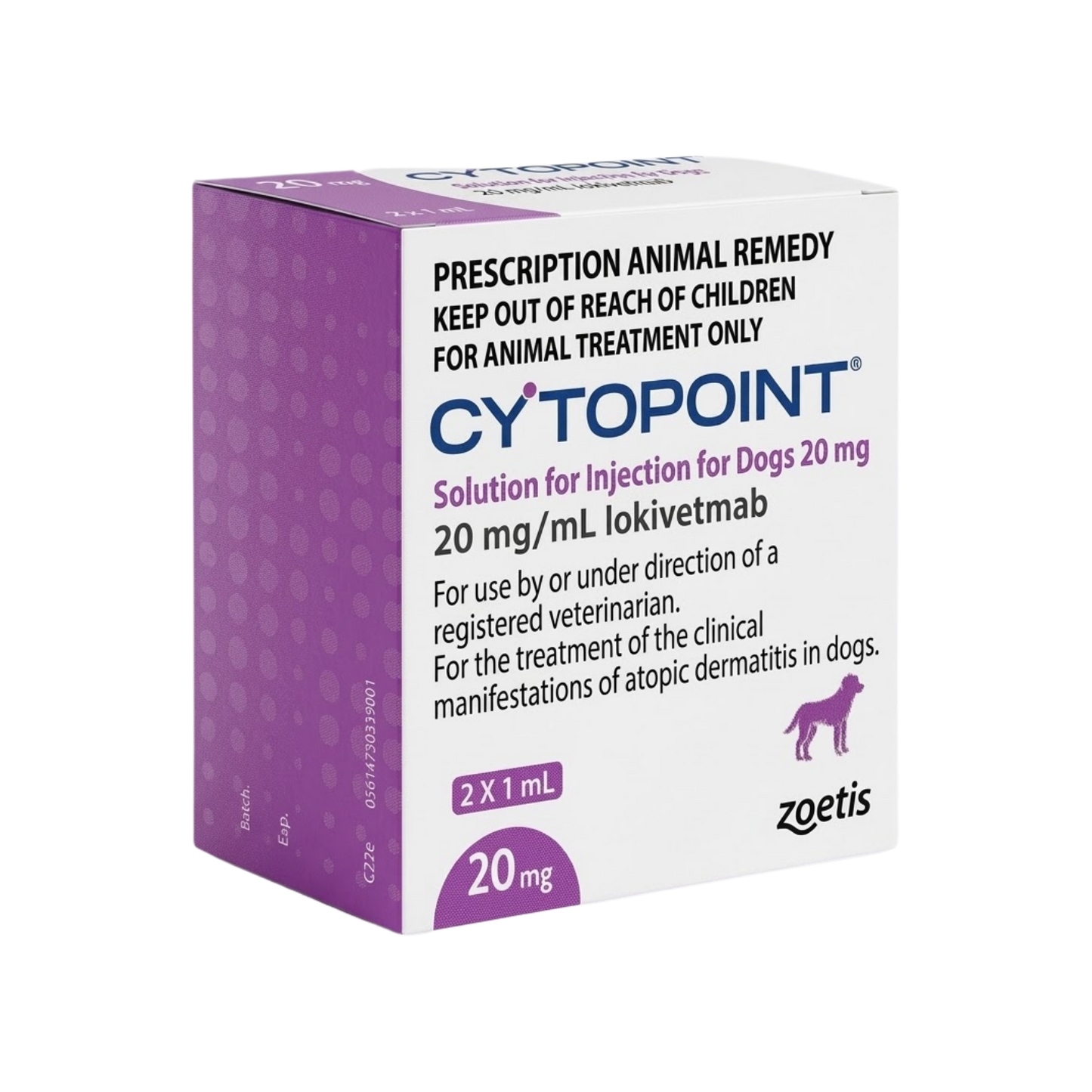
CYTOPOINT 20MG INJ
CYTOPOINT 20MG INJ
By ZOETIS
In Stock
Prescription Required
Check Availability
Rapid 3-4 Day Delivery,Tiny Extra Fee!
-
 Pet Safe
-
 Best Quality
-
 Fast Delivery
-
 Secure Payment


Cytopoint 20 mg/mL Solution for Injection by Zoetis is a revolutionary, first-in-class caninised monoclonal antibody immunotherapeutic designed to provide targeted, long-lasting relief from the relentless itch associated with atopic dermatitis and allergic dermatitis in dogs. Unlike conventional pharmaceutical treatments that broadly suppress the immune system, Cytopoint works with precision at the molecular level, neutralising the single cytokine most responsible for transmitting itch signals in your canine companion's nervous system. Each 1 mL vial contains 20 mg of Lokivetmab, a biologically engineered antibody structurally identical to the antibodies your dog's own immune system naturally produces. The result is a safe, steroid-free injection that begins controlling allergic itch within one day and delivers sustained relief for four to eight weeks per dose. Animeal is proud to offer Cytopoint 20 mg/mL as part of its commitment to bringing the most advanced, clinically validated dermatological therapies to pet parents who refuse to let their dogs suffer in silence.
Ingredients:
Lokivetmab (Active Ingredient) 20 mg per 1 mL vial: Lokivetmab is a caninised monoclonal antibody (IgG4 subclass) produced via recombinant DNA technology using Chinese Hamster Ovary (CHO) cell expression systems. "Caninised" means the antibody's protein framework is structurally modelled on a canine immunoglobulin scaffold, minimising the risk of anti-drug antibody formation that would occur with foreign protein structures. Lokivetmab targets and binds with high specificity to canine interleukin-31 (IL-31), a pro-inflammatory cytokine secreted predominantly by activated Th2 lymphocytes, mast cells, and eosinophils in allergic skin conditions. When IL-31 binds to its heterodimeric receptor complex (IL-31RA and OSMR) on cutaneous nerve fibres and keratinocytes, it triggers a cascade of downstream JAK-STAT signalling that transmits pruritic (itch) signals to the brain and drives the chronic inflammatory skin cycle of atopic dermatitis. Lokivetmab binds IL-31 before this receptor engagement can occur, completely blocking the itch signalling pathway at its upstream source. Because it acts exclusively on IL-31 without broad immune suppression, the treatment does not compromise the dog's capacity to fight infections, respond to vaccines, or regulate other immune functions.
Histidine and Histidine Hydrochloride Monohydrate (Excipient Buffer): This amino acid buffer pair maintains the formulation's pH at a stable physiological range throughout the shelf life of the product. Histidine acts as an excellent stabilising buffer for monoclonal antibody solutions, protecting the protein structure of Lokivetmab from acid-mediated denaturation or aggregation during storage and administration.
Trehalose Dihydrate (Cryoprotectant and Stabiliser): Trehalose is a disaccharide sugar that stabilises the three-dimensional protein structure of Lokivetmab in liquid formulation by forming hydrogen bonds with the antibody's polar residues, preventing misfolding, aggregation, and loss of bioactivity under thermal or mechanical stress. It serves as a critical formulation excipient for the long-term potency maintenance of the biological product under refrigerated storage.
Methionine (Antioxidant): Methionine is an amino acid included to protect Lokivetmab from oxidative degradation. As an antioxidant excipient in injectable biologics, methionine preferentially oxidises before the antibody's own methionine residues can be oxidised by reactive oxygen species, thereby preserving the binding efficacy and structural integrity of the active protein over the product's two-year shelf life.
Polysorbate 80 (Surfactant): Polysorbate 80 is a non-ionic surfactant that prevents Lokivetmab molecules from aggregating or adsorbing onto the glass vial surfaces or syringe walls during storage and handling. It reduces surface tension at air-liquid and solid-liquid interfaces, maintaining a consistent, particle-free solution that is safe for subcutaneous injection.
Disodium Edetate (Chelating Agent): Disodium edetate (EDTA) chelates trace metal ions in the solution that could otherwise catalyse oxidative degradation of the antibody protein, providing an additional layer of formulation stability.
Water for Injections: Sterile, pyrogen-free water serves as the aqueous solvent base for the solution.

CYTOPOINT 20MG INJ
In Stock
Prescription Required
Cytopoint 20 mg/mL Solution for Injection by Zoetis is a revolutionary, first-in-class caninised monoclonal antibody immunotherapeutic designed to provide targeted, long-lasting relief from the relentless itch associated with atopic dermatitis and allergic dermatitis in dogs. Unlike conventional pharmaceutical treatments that broadly suppress the immune system, Cytopoint works with precision at the molecular level, neutralising the single cytokine most responsible for transmitting itch signals in your canine companion's nervous system. Each 1 mL vial contains 20 mg of Lokivetmab, a biologically engineered antibody structurally identical to the antibodies your dog's own immune system naturally produces. The result is a safe, steroid-free injection that begins controlling allergic itch within one day and delivers sustained relief for four to eight weeks per dose. Animeal is proud to offer Cytopoint 20 mg/mL as part of its commitment to bringing the most advanced, clinically validated dermatological therapies to pet parents who refuse to let their dogs suffer in silence.
Ingredients:
Lokivetmab (Active Ingredient) 20 mg per 1 mL vial: Lokivetmab is a caninised monoclonal antibody (IgG4 subclass) produced via recombinant DNA technology using Chinese Hamster Ovary (CHO) cell expression systems. "Caninised" means the antibody's protein framework is structurally modelled on a canine immunoglobulin scaffold, minimising the risk of anti-drug antibody formation that would occur with foreign protein structures. Lokivetmab targets and binds with high specificity to canine interleukin-31 (IL-31), a pro-inflammatory cytokine secreted predominantly by activated Th2 lymphocytes, mast cells, and eosinophils in allergic skin conditions. When IL-31 binds to its heterodimeric receptor complex (IL-31RA and OSMR) on cutaneous nerve fibres and keratinocytes, it triggers a cascade of downstream JAK-STAT signalling that transmits pruritic (itch) signals to the brain and drives the chronic inflammatory skin cycle of atopic dermatitis. Lokivetmab binds IL-31 before this receptor engagement can occur, completely blocking the itch signalling pathway at its upstream source. Because it acts exclusively on IL-31 without broad immune suppression, the treatment does not compromise the dog's capacity to fight infections, respond to vaccines, or regulate other immune functions.
Histidine and Histidine Hydrochloride Monohydrate (Excipient Buffer): This amino acid buffer pair maintains the formulation's pH at a stable physiological range throughout the shelf life of the product. Histidine acts as an excellent stabilising buffer for monoclonal antibody solutions, protecting the protein structure of Lokivetmab from acid-mediated denaturation or aggregation during storage and administration.
Trehalose Dihydrate (Cryoprotectant and Stabiliser): Trehalose is a disaccharide sugar that stabilises the three-dimensional protein structure of Lokivetmab in liquid formulation by forming hydrogen bonds with the antibody's polar residues, preventing misfolding, aggregation, and loss of bioactivity under thermal or mechanical stress. It serves as a critical formulation excipient for the long-term potency maintenance of the biological product under refrigerated storage.
Methionine (Antioxidant): Methionine is an amino acid included to protect Lokivetmab from oxidative degradation. As an antioxidant excipient in injectable biologics, methionine preferentially oxidises before the antibody's own methionine residues can be oxidised by reactive oxygen species, thereby preserving the binding efficacy and structural integrity of the active protein over the product's two-year shelf life.
Polysorbate 80 (Surfactant): Polysorbate 80 is a non-ionic surfactant that prevents Lokivetmab molecules from aggregating or adsorbing onto the glass vial surfaces or syringe walls during storage and handling. It reduces surface tension at air-liquid and solid-liquid interfaces, maintaining a consistent, particle-free solution that is safe for subcutaneous injection.
Disodium Edetate (Chelating Agent): Disodium edetate (EDTA) chelates trace metal ions in the solution that could otherwise catalyse oxidative degradation of the antibody protein, providing an additional layer of formulation stability.
Water for Injections: Sterile, pyrogen-free water serves as the aqueous solvent base for the solution.