INJECTABLE

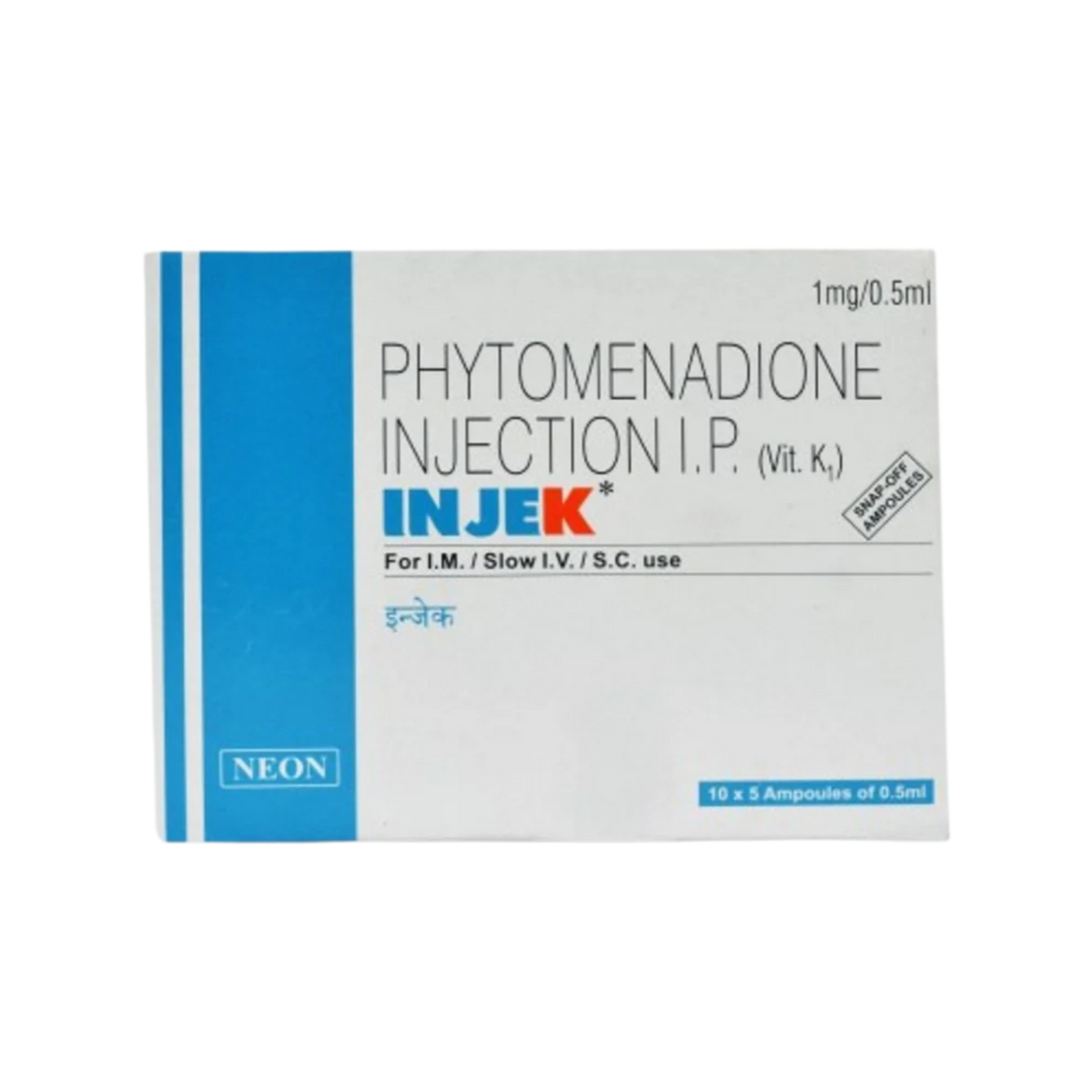
Neon Injection K 1mg Injection for Dogs and Cats, 0.5ml

Neon Injection K 1mg Injection for Dogs and Cats, 0.5ml

By NEON

Can't sell this online, but WhatsApp us to book your order!
Enquire Now

Out of Stock

Pack - 0.5mL
Expires on or after: Feb, 2028

Prescription Required question

Title

Check Availability

Rapid 3-4 Day Delivery,Tiny Extra Fee!

  • AnimealPet Safe
  • AnimealBest Quality
  • AnimealFast Delivery
  • AnimealSecure Payment
View full details

About Injection K 1mg Injection

Some medicines work best as an injection, given by a vet when a fast or reliable dose is needed.

Injection K 1mg Injection is a human injection from Neon that contains Vitamin K1 (phytomenadione). Vitamin K1 is needed for blood clotting.

It is made for people. Vets sometimes prescribe it for pets, for example for rat poison toxicity and other clotting problems. Give it to your pet only if your vet has prescribed it.

Prescription Notice

This is a prescription veterinary product. Animeal dispenses it only against a valid prescription from a registered veterinarian. You can upload the prescription at checkout or send it on WhatsApp to +91 90041 57093.

Composition

Active ingredients listed for this product. The exact strength is printed on the pack.

Ingredient What it does
Vitamin K1 (phytomenadione) Restores normal blood clotting.

Features and Benefits

  • Injection. Works quickly and gives a reliable dose when tablets are not practical.
  • Vet-guided. Your vet sets the dose and length of treatment for your pet.

How It Works

  • Vitamin K1 (phytomenadione). The liver uses it to make clotting factors.

How to Use

  • Given by a vet. Injections should be given by a vet, or by someone your vet has trained, using a sterile needle and syringe each time.
  • Dose. Your vet works out the dose from your pet's weight and condition, and decides how many injections are needed.
  • Storage. Store in a cool, dry place away from direct sunlight, unless the pack gives other storage directions. Keep out of reach of children.

Safety and Precautions

  • Give the full course. Stopping early after rat poison can lead to bleeding again.
  • Tell your vet about any other medicines your pet takes, and if your pet is pregnant, nursing or has liver or kidney problems.

Frequently Asked Questions

Do I need a prescription for Injection K 1mg Injection?

Yes. Injection K 1mg Injection is a prescription medicine. Animeal needs a valid prescription from a registered vet before it can be dispatched. You can upload it at checkout or send it on WhatsApp to +91 90041 57093.

What is Injection K 1mg Injection used for?

Injection K 1mg Injection contains Vitamin K1 (phytomenadione). Vets use it for rat poison toxicity and other clotting problems. Your vet decides whether it is right for your pet and for how long.

Can I give Injection K 1mg Injection at home?

Only if your vet has prescribed it and shown you how to inject safely. Most injections are given at the clinic.

Also in: Injectables for Dogs · Injectables for Cats · All Dog Products · All Cat Products

Product Information

Detail Information
Brand Neon
Active ingredients Vitamin K1 (phytomenadione)
Form Injection
Pack size 0.5ml
Suitable for Dogs and cats
Made for People. Use for pets only on a vet's prescription
Prescription Required
Sold by Goodman Vetcare Pvt. Ltd. (Animeal), Warehouse No - 501 5th floor, Bharat industrial estate, Tokershi Jivraj Rd, Sewree West, Sindhu Nagar, Sewri, Mumbai, Maharashtra 400015

This product requires a valid prescription from a registered veterinarian. Animeal shares this information for educational purposes only. Always consult your vet before use.

Definitive Antidote for Anticoagulant Rodenticide Toxicosis The Primary & Most Critical Indication: Phytomenadione injection is the only specific, direct-acting pharmacological antidote for anticoagulant rodenticide (rat poison) toxicity in dogs, cats, and other domestic animals. There is no substitute, no comparable alternative, and no time to delay in animals presenting with active haemorrhage secondary to rodenticide toxicosis, immediate Phytomenadione administration alongside supportive care (plasma, whole blood transfusion for active haemorrhage) is the sole intervention that can reverse the coagulopathy and prevent death from internal or external haemorrhage

Measurable Improvement in Prothrombin Time Within 1–2 Hours: parenteral Phytomenadione administration produces measurable improvement in prothrombin time within 1 to 2 hours of administration confirming restoration of active Vitamin K-dependent clotting factor synthesis. This rapid clinical response is an important prognostic marker monitoring PT every 12 to 24 hours guides the adequacy of dosing and the duration of therapy required

Effective Against ALL Anticoagulant Rodenticides Including Long-Acting Second-Generation Compounds: Phytomenadione is equally effective against both first-generation (warfarin, diphacinone, chlorophacinone) and second-generation (brodifacoum, bromadiolone, difethialone) anticoagulant rodenticides though the treatment duration for second-generation compounds is dramatically longer (4 to 6 weeks versus 5 to 7 days for first-generation) due to their very long tissue half-lives and extremely high VKOR binding affinity

Treatment of Vitamin K Deficiency from Hepatic Disease: severe hepatic disease impairs Vitamin K absorption, storage, and activation Phytomenadione injection provides direct, reliable Vitamin K repletion in hepatic-compromised patients where oral supplementation may be poorly absorbed or inadequate for maintaining haemostatic competence in severely jaundiced or cirrhotic animals

Management of Coumarin Toxicosis from Sweet Clover / Bishydroxycoumarin: specifically indicated for hypoprothrombinemia caused by consumption of spoiled or mouldy sweet clover containing naturally occurring Bishydroxycoumarin a relevant indication in Indian livestock and horses with access to deteriorated forage

Reversal of Excessive Anticoagulation from Warfarin Therapy: in animals receiving warfarin anticoagulation therapy (uncommon but used in some cardiovascular conditions), Phytomenadione reverses excessive anticoagulation when prothrombin time is dangerously elevated or spontaneous haemorrhage occurs however, this must be balanced carefully against the risk of restoring the pro-thrombotic state that made anticoagulation necessary

Parenteral Route for Guaranteed Bioavailability in Emergency Presentations: oral Vitamin K1 absorption requires intact fat absorption, functioning intestinal mucosa, and adequate bile salt availability all of which may be compromised in severely ill, jaundiced, or haemorrhaging emergency patients. Injectable Phytomenadione bypasses all gastrointestinal absorption variables, delivering 100% bioavailability directly into the systemic circulation for immediate hepatic uptake and utilisation making it the essential formulation for the initial emergency management of all Vitamin K1-responsive coagulopathies

How to Administer:

For subcutaneous (S/C) or intramuscular (I/M) administration by or under the direct supervision of a licensed veterinarian only these routes are strongly preferred over the intravenous route. Draw the calculated dose into a sterile syringe using aseptic technique. For subcutaneous administration, pinch a skin fold over the dorsal neck or interscapular region and inject the calculated dose. For intramuscular administration, inject into the epaxial muscles or hindlimb. If intravenous administration is considered unavoidable in a critical emergency, the drug must be diluted in compatible IV fluid and administered very slowly not exceeding 1mg per minute with the patient under close monitoring for anaphylactoid reactions.

Storage Advice:

Store Injek Injection at controlled room temperature between 15°C and 30°C. Protect strictly from light at all times Phytomenadione is highly photosensitive and light exposure causes rapid degradation. Store in the original dark packaging until immediately before use. Do not freeze. Keep out of reach of children. Do not use after the expiry date on the ampoule. Inspect each ampoule visually before use do not use if particulate matter is present or the solution appears discoloured.

About the Brand:

Neon Laboratories Ltd. is a trusted and established Indian pharmaceutical company headquartered in Andheri (East), Mumbai with decades of pharmaceutical manufacturing experience across human injectables, oral formulations, and specialty pharmaceutical products. Their Injek Phytomenadione Injection represents the pharmaceutical-grade quality manufacturing precision, active ingredient concentration accuracy, and strict sterility assurance that veterinarians depend upon when administering a life-saving antidote to a critically ill patient. Neon Laboratories' commitment to accessible, quality-assured pharmaceutical manufacturing aligns perfectly with Animeal's mission to provide registered veterinary professionals across India with reliable access to the veterinary pharmaceutical tools needed at every critical clinical moment.

Disclaimer:

Injek Phytomenadione Injection is a prescription-only human pharmaceutical product with well-documented, critically important veterinary application as the definitive antidote for anticoagulant rodenticide toxicosis and treatment of Vitamin K-responsive coagulopathies in companion and livestock animals. It must be prescribed, dosed, and administered exclusively by or under the direct supervision of a licensed veterinarian. Intravenous administration is associated with a risk of severe anaphylactoid reactions and fatalities subcutaneous or intramuscular routes are mandatory in all but the most critical emergencies, and IV administration should only be considered when the S/C/IM routes are genuinely impractical, with appropriate resuscitation equipment immediately available. Phytomenadione will not reverse the anticoagulant effect of heparin. An immediate coagulant effect should not be expected a minimum of 1 to 2 hours is required for measurable PT improvement. Prothrombin time monitoring is essential throughout the treatment course to guide dosing adequacy and duration. Treatment duration for second-generation rodenticides (brodifacoum, bromadiolone) typically spans 4 to 6 weeks premature discontinuation before the rodenticide is eliminated causes relapse of potentially fatal coagulopathy. Animeal facilitates enquiry and procurement for registered veterinary professionals only.

Q: Why is anticoagulant rodenticide toxicosis such a common and urgent emergency in Indian veterinary practice, and why is parenteral Phytomenadione the treatment of choice?
India's dense urban and peri-urban population creates a very high density of rat and rodent pest control measures anticoagulant rodenticide baits (containing brodifacoum, bromadiolone, warfarin, and related compounds) are widely deployed in homes, kitchens, restaurants, markets, warehouses, and agricultural settings. Free-roaming dogs and indoor dogs and cats frequently access these baits through curiosity and food-motivated scavenging particularly given the palatability of commercial bait formulations. Once ingested, anticoagulant rodenticides inhibit Vitamin K-dependent clotting factor synthesis, creating a progressive, sometimes catastrophically rapid coagulopathy within 24 to 72 hours of ingestion. Parenteral Phytomenadione is the treatment of choice because it provides immediate, 100% bioavailable Vitamin K1 directly to the liver that bypasses all gastrointestinal absorption variables achieving measurable PT improvement within 1 to 2 hours and restoring haemostatic competence before haemorrhage becomes fatal.
Q: How do veterinarians differentiate first-generation from second-generation rodenticide toxicosis and why does it matter for treatment duration?
The distinction between first-generation (warfarin, diphacinone, chlorophacinone) and second-generation (brodifacoum, bromadiolone, difethialone) anticoagulant rodenticides is critically important because it determines the required treatment duration and premature discontinuation of Phytomenadione before the rodenticide is fully eliminated causes relapse of potentially fatal coagulopathy. First-generation rodenticides have shorter half-lives and weaker VKOR binding, and 5 to 7 days of Phytomenadione therapy is usually sufficient. Second-generation rodenticides bind VKOR with very high affinity and have exceptionally long tissue half-lives brodifacoum may persist in hepatic tissue for 4 to 6 months after a single ingestion, requiring 4 to 6 continuous weeks of Phytomenadione supplementation. Most commercial rodenticide baits available in India today contain brodifacoum or bromadiolone veterinarians should assume second-generation toxicosis and treat for the full 4 to 6 week duration unless the specific product has been definitively identified as first-generation.
Q: What is the proper PT monitoring protocol for an animal being treated for rodenticide toxicosis with Phytomenadione?
PT monitoring is the essential clinical tool for guiding Phytomenadione therapy it is the only reliable way to confirm adequate treatment response, identify dosing inadequacy, and determine safe treatment discontinuation. The recommended protocol involves a baseline PT measurement before the first Phytomenadione dose, a follow-up PT at 12 to 24 hours to confirm the expected improvement in clotting times, and periodic PT monitoring throughout the treatment course to detect any deterioration suggesting dose inadequacy or rodenticide-induced resistance. Most critically a PT must always be checked 48 to 72 hours after the planned final Phytomenadione dose. If PT prolongs again at this timepoint, the rodenticide is still active and Phytomenadione therapy must be continued for another 1 to 2 weeks before repeating the off-drug PT check. The animal should be declared free of rodenticide activity only when PT remains normal 48 to 72 hours after the last dose.
Q: What are the most important safety precautions for Phytomenadione injection administration in dogs and cats?
The most critical safety consideration is the avoidance of intravenous administration wherever possible subcutaneous injection is the strongly preferred route, with intramuscular as an acceptable alternative. The colloidal vehicle (Cremophor EL / polyethoxylated castor oil) used to solubilise Phytomenadione can trigger severe complement activation-related anaphylactoid reactions upon IV injection this is a non-immunological reaction that does not require prior sensitisation and can occur on first exposure, causing cardiovascular collapse and death. Always administer subcutaneously and slowly. Keep the patient under observation for at least 30 minutes post-injection. Always have adrenaline (epinephrine) and resuscitation materials immediately available whenever parenteral Vitamin K1 is administered. Avoid intramuscular injection in actively haemorrhaging patients haematoma formation at IM injection sites can complicate clinical assessment.
Q: How can veterinary clinics procure Injek Phytomenadione Injection through Animeal?
Registered veterinary practitioners, veterinary clinics, and animal hospitals can enquire about and procure Injek Phytomenadione 1mg Injection through Animeal's dedicated veterinary pharmaceutical enquiry channel. Please use the Enquire Now button on this product page or contact our veterinary pharma team directly via WhatsApp or phone with your practice registration details. Our team will respond promptly with product availability, current pricing, pack size options, and delivery arrangements to your registered clinic or hospital address anywhere across India.
Neon Injection K 1mg Injection for Dogs and Cats, 0.5ml - Animeal
INJECTABLE
🚚 Free Delivery Above ₹499 - Pan India
10 DaysEasy Returns
100%Authentic
SecurePayments
INJECTABLE

Neon Injection K 1mg Injection for Dogs and Cats, 0.5ml

By NEON
WhatsApp us to book your order!

Out of Stock

Expires on or after: Feb, 2028
Size

Prescription Required question

Check Availability

About Injection K 1mg Injection

Some medicines work best as an injection, given by a vet when a fast or reliable dose is needed.

Injection K 1mg Injection is a human injection from Neon that contains Vitamin K1 (phytomenadione). Vitamin K1 is needed for blood clotting.

It is made for people. Vets sometimes prescribe it for pets, for example for rat poison toxicity and other clotting problems. Give it to your pet only if your vet has prescribed it.

Prescription Notice

This is a prescription veterinary product. Animeal dispenses it only against a valid prescription from a registered veterinarian. You can upload the prescription at checkout or send it on WhatsApp to +91 90041 57093.

Composition

Active ingredients listed for this product. The exact strength is printed on the pack.

Ingredient What it does
Vitamin K1 (phytomenadione) Restores normal blood clotting.

Features and Benefits

  • Injection. Works quickly and gives a reliable dose when tablets are not practical.
  • Vet-guided. Your vet sets the dose and length of treatment for your pet.

How It Works

  • Vitamin K1 (phytomenadione). The liver uses it to make clotting factors.

How to Use

  • Given by a vet. Injections should be given by a vet, or by someone your vet has trained, using a sterile needle and syringe each time.
  • Dose. Your vet works out the dose from your pet's weight and condition, and decides how many injections are needed.
  • Storage. Store in a cool, dry place away from direct sunlight, unless the pack gives other storage directions. Keep out of reach of children.

Safety and Precautions

  • Give the full course. Stopping early after rat poison can lead to bleeding again.
  • Tell your vet about any other medicines your pet takes, and if your pet is pregnant, nursing or has liver or kidney problems.

Frequently Asked Questions

Do I need a prescription for Injection K 1mg Injection?

Yes. Injection K 1mg Injection is a prescription medicine. Animeal needs a valid prescription from a registered vet before it can be dispatched. You can upload it at checkout or send it on WhatsApp to +91 90041 57093.

What is Injection K 1mg Injection used for?

Injection K 1mg Injection contains Vitamin K1 (phytomenadione). Vets use it for rat poison toxicity and other clotting problems. Your vet decides whether it is right for your pet and for how long.

Can I give Injection K 1mg Injection at home?

Only if your vet has prescribed it and shown you how to inject safely. Most injections are given at the clinic.

Also in: Injectables for Dogs · Injectables for Cats · All Dog Products · All Cat Products

Product Information

Detail Information
Brand Neon
Active ingredients Vitamin K1 (phytomenadione)
Form Injection
Pack size 0.5ml
Suitable for Dogs and cats
Made for People. Use for pets only on a vet's prescription
Prescription Required
Sold by Goodman Vetcare Pvt. Ltd. (Animeal), Warehouse No - 501 5th floor, Bharat industrial estate, Tokershi Jivraj Rd, Sewree West, Sindhu Nagar, Sewri, Mumbai, Maharashtra 400015

This product requires a valid prescription from a registered veterinarian. Animeal shares this information for educational purposes only. Always consult your vet before use.

Definitive Antidote for Anticoagulant Rodenticide Toxicosis The Primary & Most Critical Indication: Phytomenadione injection is the only specific, direct-acting pharmacological antidote for anticoagulant rodenticide (rat poison) toxicity in dogs, cats, and other domestic animals. There is no substitute, no comparable alternative, and no time to delay in animals presenting with active haemorrhage secondary to rodenticide toxicosis, immediate Phytomenadione administration alongside supportive care (plasma, whole blood transfusion for active haemorrhage) is the sole intervention that can reverse the coagulopathy and prevent death from internal or external haemorrhage

Measurable Improvement in Prothrombin Time Within 1–2 Hours: parenteral Phytomenadione administration produces measurable improvement in prothrombin time within 1 to 2 hours of administration confirming restoration of active Vitamin K-dependent clotting factor synthesis. This rapid clinical response is an important prognostic marker monitoring PT every 12 to 24 hours guides the adequacy of dosing and the duration of therapy required

Effective Against ALL Anticoagulant Rodenticides Including Long-Acting Second-Generation Compounds: Phytomenadione is equally effective against both first-generation (warfarin, diphacinone, chlorophacinone) and second-generation (brodifacoum, bromadiolone, difethialone) anticoagulant rodenticides though the treatment duration for second-generation compounds is dramatically longer (4 to 6 weeks versus 5 to 7 days for first-generation) due to their very long tissue half-lives and extremely high VKOR binding affinity

Treatment of Vitamin K Deficiency from Hepatic Disease: severe hepatic disease impairs Vitamin K absorption, storage, and activation Phytomenadione injection provides direct, reliable Vitamin K repletion in hepatic-compromised patients where oral supplementation may be poorly absorbed or inadequate for maintaining haemostatic competence in severely jaundiced or cirrhotic animals

Management of Coumarin Toxicosis from Sweet Clover / Bishydroxycoumarin: specifically indicated for hypoprothrombinemia caused by consumption of spoiled or mouldy sweet clover containing naturally occurring Bishydroxycoumarin a relevant indication in Indian livestock and horses with access to deteriorated forage

Reversal of Excessive Anticoagulation from Warfarin Therapy: in animals receiving warfarin anticoagulation therapy (uncommon but used in some cardiovascular conditions), Phytomenadione reverses excessive anticoagulation when prothrombin time is dangerously elevated or spontaneous haemorrhage occurs however, this must be balanced carefully against the risk of restoring the pro-thrombotic state that made anticoagulation necessary

Parenteral Route for Guaranteed Bioavailability in Emergency Presentations: oral Vitamin K1 absorption requires intact fat absorption, functioning intestinal mucosa, and adequate bile salt availability all of which may be compromised in severely ill, jaundiced, or haemorrhaging emergency patients. Injectable Phytomenadione bypasses all gastrointestinal absorption variables, delivering 100% bioavailability directly into the systemic circulation for immediate hepatic uptake and utilisation making it the essential formulation for the initial emergency management of all Vitamin K1-responsive coagulopathies

How to Administer:

For subcutaneous (S/C) or intramuscular (I/M) administration by or under the direct supervision of a licensed veterinarian only these routes are strongly preferred over the intravenous route. Draw the calculated dose into a sterile syringe using aseptic technique. For subcutaneous administration, pinch a skin fold over the dorsal neck or interscapular region and inject the calculated dose. For intramuscular administration, inject into the epaxial muscles or hindlimb. If intravenous administration is considered unavoidable in a critical emergency, the drug must be diluted in compatible IV fluid and administered very slowly not exceeding 1mg per minute with the patient under close monitoring for anaphylactoid reactions.

Storage Advice:

Store Injek Injection at controlled room temperature between 15°C and 30°C. Protect strictly from light at all times Phytomenadione is highly photosensitive and light exposure causes rapid degradation. Store in the original dark packaging until immediately before use. Do not freeze. Keep out of reach of children. Do not use after the expiry date on the ampoule. Inspect each ampoule visually before use do not use if particulate matter is present or the solution appears discoloured.

About the Brand:

Neon Laboratories Ltd. is a trusted and established Indian pharmaceutical company headquartered in Andheri (East), Mumbai with decades of pharmaceutical manufacturing experience across human injectables, oral formulations, and specialty pharmaceutical products. Their Injek Phytomenadione Injection represents the pharmaceutical-grade quality manufacturing precision, active ingredient concentration accuracy, and strict sterility assurance that veterinarians depend upon when administering a life-saving antidote to a critically ill patient. Neon Laboratories' commitment to accessible, quality-assured pharmaceutical manufacturing aligns perfectly with Animeal's mission to provide registered veterinary professionals across India with reliable access to the veterinary pharmaceutical tools needed at every critical clinical moment.

Disclaimer:

Injek Phytomenadione Injection is a prescription-only human pharmaceutical product with well-documented, critically important veterinary application as the definitive antidote for anticoagulant rodenticide toxicosis and treatment of Vitamin K-responsive coagulopathies in companion and livestock animals. It must be prescribed, dosed, and administered exclusively by or under the direct supervision of a licensed veterinarian. Intravenous administration is associated with a risk of severe anaphylactoid reactions and fatalities subcutaneous or intramuscular routes are mandatory in all but the most critical emergencies, and IV administration should only be considered when the S/C/IM routes are genuinely impractical, with appropriate resuscitation equipment immediately available. Phytomenadione will not reverse the anticoagulant effect of heparin. An immediate coagulant effect should not be expected a minimum of 1 to 2 hours is required for measurable PT improvement. Prothrombin time monitoring is essential throughout the treatment course to guide dosing adequacy and duration. Treatment duration for second-generation rodenticides (brodifacoum, bromadiolone) typically spans 4 to 6 weeks premature discontinuation before the rodenticide is eliminated causes relapse of potentially fatal coagulopathy. Animeal facilitates enquiry and procurement for registered veterinary professionals only.

Q: Why is anticoagulant rodenticide toxicosis such a common and urgent emergency in Indian veterinary practice, and why is parenteral Phytomenadione the treatment of choice?
India's dense urban and peri-urban population creates a very high density of rat and rodent pest control measures anticoagulant rodenticide baits (containing brodifacoum, bromadiolone, warfarin, and related compounds) are widely deployed in homes, kitchens, restaurants, markets, warehouses, and agricultural settings. Free-roaming dogs and indoor dogs and cats frequently access these baits through curiosity and food-motivated scavenging particularly given the palatability of commercial bait formulations. Once ingested, anticoagulant rodenticides inhibit Vitamin K-dependent clotting factor synthesis, creating a progressive, sometimes catastrophically rapid coagulopathy within 24 to 72 hours of ingestion. Parenteral Phytomenadione is the treatment of choice because it provides immediate, 100% bioavailable Vitamin K1 directly to the liver that bypasses all gastrointestinal absorption variables achieving measurable PT improvement within 1 to 2 hours and restoring haemostatic competence before haemorrhage becomes fatal.
Q: How do veterinarians differentiate first-generation from second-generation rodenticide toxicosis and why does it matter for treatment duration?
The distinction between first-generation (warfarin, diphacinone, chlorophacinone) and second-generation (brodifacoum, bromadiolone, difethialone) anticoagulant rodenticides is critically important because it determines the required treatment duration and premature discontinuation of Phytomenadione before the rodenticide is fully eliminated causes relapse of potentially fatal coagulopathy. First-generation rodenticides have shorter half-lives and weaker VKOR binding, and 5 to 7 days of Phytomenadione therapy is usually sufficient. Second-generation rodenticides bind VKOR with very high affinity and have exceptionally long tissue half-lives brodifacoum may persist in hepatic tissue for 4 to 6 months after a single ingestion, requiring 4 to 6 continuous weeks of Phytomenadione supplementation. Most commercial rodenticide baits available in India today contain brodifacoum or bromadiolone veterinarians should assume second-generation toxicosis and treat for the full 4 to 6 week duration unless the specific product has been definitively identified as first-generation.
Q: What is the proper PT monitoring protocol for an animal being treated for rodenticide toxicosis with Phytomenadione?
PT monitoring is the essential clinical tool for guiding Phytomenadione therapy it is the only reliable way to confirm adequate treatment response, identify dosing inadequacy, and determine safe treatment discontinuation. The recommended protocol involves a baseline PT measurement before the first Phytomenadione dose, a follow-up PT at 12 to 24 hours to confirm the expected improvement in clotting times, and periodic PT monitoring throughout the treatment course to detect any deterioration suggesting dose inadequacy or rodenticide-induced resistance. Most critically a PT must always be checked 48 to 72 hours after the planned final Phytomenadione dose. If PT prolongs again at this timepoint, the rodenticide is still active and Phytomenadione therapy must be continued for another 1 to 2 weeks before repeating the off-drug PT check. The animal should be declared free of rodenticide activity only when PT remains normal 48 to 72 hours after the last dose.
Q: What are the most important safety precautions for Phytomenadione injection administration in dogs and cats?
The most critical safety consideration is the avoidance of intravenous administration wherever possible subcutaneous injection is the strongly preferred route, with intramuscular as an acceptable alternative. The colloidal vehicle (Cremophor EL / polyethoxylated castor oil) used to solubilise Phytomenadione can trigger severe complement activation-related anaphylactoid reactions upon IV injection this is a non-immunological reaction that does not require prior sensitisation and can occur on first exposure, causing cardiovascular collapse and death. Always administer subcutaneously and slowly. Keep the patient under observation for at least 30 minutes post-injection. Always have adrenaline (epinephrine) and resuscitation materials immediately available whenever parenteral Vitamin K1 is administered. Avoid intramuscular injection in actively haemorrhaging patients haematoma formation at IM injection sites can complicate clinical assessment.
Q: How can veterinary clinics procure Injek Phytomenadione Injection through Animeal?
Registered veterinary practitioners, veterinary clinics, and animal hospitals can enquire about and procure Injek Phytomenadione 1mg Injection through Animeal's dedicated veterinary pharmaceutical enquiry channel. Please use the Enquire Now button on this product page or contact our veterinary pharma team directly via WhatsApp or phone with your practice registration details. Our team will respond promptly with product availability, current pricing, pack size options, and delivery arrangements to your registered clinic or hospital address anywhere across India.

Frequently Asked Questions

Why is anticoagulant rodenticide toxicosis such a common and urgent emergency in Indian veterinary practice, and why is parenteral Phytomenadione the treatment of choice?

India's dense urban and peri-urban population creates a very high density of rat and rodent pest control measures anticoagulant rodenticide baits (containing brodifacoum, bromadiolone, warfarin, and related compounds) are widely deployed in homes, kitchens, restaurants, markets, warehouses, and agricultural settings. Free-roaming dogs and indoor dogs and cats frequently access these baits through curiosity and food-motivated scavenging particularly given the palatability of commercial bait formulations. Once ingested, anticoagulant rodenticides inhibit Vitamin K-dependent clotting factor synthesis, creating a progressive, sometimes catastrophically rapid coagulopathy within 24 to 72 hours of ingestion. Parenteral Phytomenadione is the treatment of choice because it provides immediate, 100% bioavailable Vitamin K1 directly to the liver that bypasses all gastrointestinal absorption variables achieving measurable PT improvement within 1 to 2 hours and restoring haemostatic competence before haemorrhage becomes fatal.

How do veterinarians differentiate first-generation from second-generation rodenticide toxicosis and why does it matter for treatment duration?

The distinction between first-generation (warfarin, diphacinone, chlorophacinone) and second-generation (brodifacoum, bromadiolone, difethialone) anticoagulant rodenticides is critically important because it determines the required treatment duration and premature discontinuation of Phytomenadione before the rodenticide is fully eliminated causes relapse of potentially fatal coagulopathy. First-generation rodenticides have shorter half-lives and weaker VKOR binding, and 5 to 7 days of Phytomenadione therapy is usually sufficient. Second-generation rodenticides bind VKOR with very high affinity and have exceptionally long tissue half-lives brodifacoum may persist in hepatic tissue for 4 to 6 months after a single ingestion, requiring 4 to 6 continuous weeks of Phytomenadione supplementation. Most commercial rodenticide baits available in India today contain brodifacoum or bromadiolone veterinarians should assume second-generation toxicosis and treat for the full 4 to 6 week duration unless the specific product has been definitively identified as first-generation.

What is the proper PT monitoring protocol for an animal being treated for rodenticide toxicosis with Phytomenadione?

PT monitoring is the essential clinical tool for guiding Phytomenadione therapy it is the only reliable way to confirm adequate treatment response, identify dosing inadequacy, and determine safe treatment discontinuation. The recommended protocol involves a baseline PT measurement before the first Phytomenadione dose, a follow-up PT at 12 to 24 hours to confirm the expected improvement in clotting times, and periodic PT monitoring throughout the treatment course to detect any deterioration suggesting dose inadequacy or rodenticide-induced resistance. Most critically a PT must always be checked 48 to 72 hours after the planned final Phytomenadione dose. If PT prolongs again at this timepoint, the rodenticide is still active and Phytomenadione therapy must be continued for another 1 to 2 weeks before repeating the off-drug PT check. The animal should be declared free of rodenticide activity only when PT remains normal 48 to 72 hours after the last dose.

What are the most important safety precautions for Phytomenadione injection administration in dogs and cats?

The most critical safety consideration is the avoidance of intravenous administration wherever possible subcutaneous injection is the strongly preferred route, with intramuscular as an acceptable alternative. The colloidal vehicle (Cremophor EL / polyethoxylated castor oil) used to solubilise Phytomenadione can trigger severe complement activation-related anaphylactoid reactions upon IV injection this is a non-immunological reaction that does not require prior sensitisation and can occur on first exposure, causing cardiovascular collapse and death. Always administer subcutaneously and slowly. Keep the patient under observation for at least 30 minutes post-injection. Always have adrenaline (epinephrine) and resuscitation materials immediately available whenever parenteral Vitamin K1 is administered. Avoid intramuscular injection in actively haemorrhaging patients haematoma formation at IM injection sites can complicate clinical assessment.

How can veterinary clinics procure Injek Phytomenadione Injection through Animeal?

Registered veterinary practitioners, veterinary clinics, and animal hospitals can enquire about and procure Injek Phytomenadione 1mg Injection through Animeal's dedicated veterinary pharmaceutical enquiry channel. Please use the Enquire Now button on this product page or contact our veterinary pharma team directly via WhatsApp or phone with your practice registration details. Our team will respond promptly with product availability, current pricing, pack size options, and delivery arrangements to your registered clinic or hospital address anywhere across India.