Skip to content


INJECTABLE
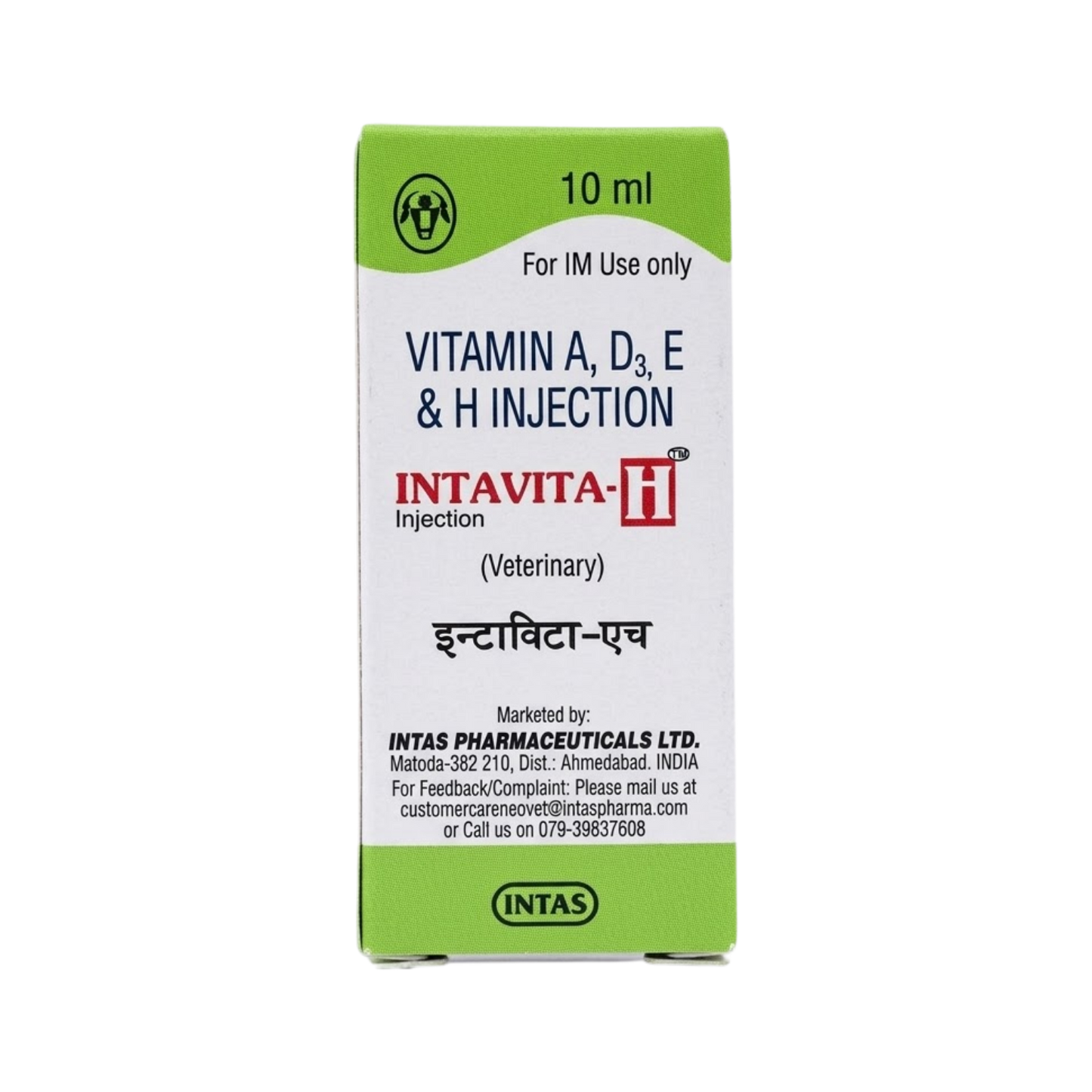
Intavita-h Inj
Intavita-h Inj
By INTAS
In Stock
Prescription Required
Couldn't load pickup availability
Check Availability
Rapid 3-4 Day Delivery,Tiny Extra Fee!
-
 Pet Safe
-
 Best Quality
-
 Fast Delivery
-
 Secure Payment


INTAVITA-H INJ by Intas Animal Health is a Schedule H, prescription-only, high-potency parenteral multivitamin injection formulated to address the complex and often critical problem of fat-soluble vitamin and biotin deficiency in livestock. Vitamin deficiency in farm animals is far from a superficial concern it is a root cause of infertility, impaired fetal development, skeletal disorders, compromised immune defence, and poor productivity, especially during physiologically demanding periods such as pregnancy, lactation, and post-partum recovery. INTAVITA-H INJ delivers a scientifically calibrated combination of Vitamin A, Vitamin D3, Vitamin E, and Biotin via intramuscular injection bypassing the gut entirely to ensure rapid, reliable absorption where it matters most. Suitable for cattle, buffalo, cows, calves, dogs, cats, pigs, sheep, and goats, this formulation supports reproductive success, bone integrity, immune resilience, and metabolic stability across a broad range of species and life stages. Animeal is proud to offer INTAVITA-H INJ as part of its commitment to science-backed, veterinarian-trusted livestock healthcare.
Ingredients:
Vitamin A Palmitate 2,50,000 IU per mL: Vitamin A Palmitate (retinyl palmitate) is the esterified, storage form of retinol a fat-soluble vitamin that is indispensable to vision, epithelial integrity, immune function, and reproductive physiology. At the cellular level, retinol is converted to retinoic acid, which binds nuclear retinoic acid receptors (RARs) to regulate gene expression governing cellular differentiation, mucous membrane maintenance, and spermatogenesis. In deficient animals, retinal photoreceptors degrade, leading to night blindness and xerophthalmia; reproductive epithelia deteriorate, causing anestrus, infertility, and early embryonic loss. Palmitate esterification enhances stability in injectable formulations while delivering a concentrated retinol depot that is rapidly mobilised by hepatic esterases upon administration.
Vitamin D3 (Cholecalciferol) 25,000 IU per mL: Cholecalciferol is the biologically active precursor to calcitriol (1,25-dihydroxyvitamin D3) the hormone that governs calcium and phosphorus absorption at the intestinal level and regulates skeletal mineralisation. After injection, Vitamin D3 undergoes hepatic 25-hydroxylation and renal 1-alpha-hydroxylation to yield calcitriol, which binds the vitamin D receptor (VDR) in osteoblasts, intestinal enterocytes, and immune cells. In deficient cattle and buffalo, this cascade fails, resulting in rickets in young animals and osteomalacia in adults, along with impaired calcium mobilisation during lactation (milk fever risk). Parenteral Vitamin D3 rapidly restores this hormonal axis, supporting hoof integrity, udder health, and uterine contractility post-partum.
Vitamin E Acetate (dl-Alpha Tocopherol Acetate)100 IU per mL: Vitamin E acetate is a stabilised form of alpha-tocopherol, the most biologically active naturally occurring tocopherol and the body's principal lipid-soluble antioxidant. Once absorbed, the acetate ester is cleaved by tissue esterases to release free tocopherol, which integrates into cell membranes and neutralises lipid peroxyl radicals preventing oxidative chain reactions that damage polyunsaturated fatty acids within cell membranes. In livestock under metabolic stress (transport, extreme weather, parasitic load), reactive oxygen species surge, impairing immune cell function, sperm viability, and uterine health. Vitamin E works synergistically with selenium to reinforce the glutathione peroxidase antioxidant system, reducing retained placenta rates and improving post-partum uterine recovery.
Biotin (Vitamin H / Vitamin B7) 12.5 mcg per mL: Biotin is a water-soluble B-vitamin that serves as a covalently bound coenzyme for five critical carboxylase enzymes involved in fatty acid synthesis, amino acid catabolism (leucine, isoleucine, valine), and gluconeogenesis. In hoof tissue, biotin plays a direct structural role: it participates in the synthesis of keratin precursors and the cross-linking of proteins within the hoof horn matrix, directly influencing hoof hardness, wall integrity, and the thickness of the white line. Biotin deficiency in cattle manifests as soft, crumbling hooves, laminitis susceptibility, and poor hoof wall regeneration. Parenteral delivery of biotin ensures systemic availability without reliance on rumen microbial synthesis, which can be inconsistent in stressed or subclinically ill animals.
Benzyl Alcohol 2% w/v: Benzyl alcohol functions as an antimicrobial preservative in the formulation, maintaining sterility of the multi-dose vial across its usage period. It prevents microbial contamination without interfering with the biological activity of the active vitamins.

Intavita-h Inj
In Stock
Prescription Required
INTAVITA-H INJ by Intas Animal Health is a Schedule H, prescription-only, high-potency parenteral multivitamin injection formulated to address the complex and often critical problem of fat-soluble vitamin and biotin deficiency in livestock. Vitamin deficiency in farm animals is far from a superficial concern it is a root cause of infertility, impaired fetal development, skeletal disorders, compromised immune defence, and poor productivity, especially during physiologically demanding periods such as pregnancy, lactation, and post-partum recovery. INTAVITA-H INJ delivers a scientifically calibrated combination of Vitamin A, Vitamin D3, Vitamin E, and Biotin via intramuscular injection bypassing the gut entirely to ensure rapid, reliable absorption where it matters most. Suitable for cattle, buffalo, cows, calves, dogs, cats, pigs, sheep, and goats, this formulation supports reproductive success, bone integrity, immune resilience, and metabolic stability across a broad range of species and life stages. Animeal is proud to offer INTAVITA-H INJ as part of its commitment to science-backed, veterinarian-trusted livestock healthcare.
Ingredients:
Vitamin A Palmitate 2,50,000 IU per mL: Vitamin A Palmitate (retinyl palmitate) is the esterified, storage form of retinol a fat-soluble vitamin that is indispensable to vision, epithelial integrity, immune function, and reproductive physiology. At the cellular level, retinol is converted to retinoic acid, which binds nuclear retinoic acid receptors (RARs) to regulate gene expression governing cellular differentiation, mucous membrane maintenance, and spermatogenesis. In deficient animals, retinal photoreceptors degrade, leading to night blindness and xerophthalmia; reproductive epithelia deteriorate, causing anestrus, infertility, and early embryonic loss. Palmitate esterification enhances stability in injectable formulations while delivering a concentrated retinol depot that is rapidly mobilised by hepatic esterases upon administration.
Vitamin D3 (Cholecalciferol) 25,000 IU per mL: Cholecalciferol is the biologically active precursor to calcitriol (1,25-dihydroxyvitamin D3) the hormone that governs calcium and phosphorus absorption at the intestinal level and regulates skeletal mineralisation. After injection, Vitamin D3 undergoes hepatic 25-hydroxylation and renal 1-alpha-hydroxylation to yield calcitriol, which binds the vitamin D receptor (VDR) in osteoblasts, intestinal enterocytes, and immune cells. In deficient cattle and buffalo, this cascade fails, resulting in rickets in young animals and osteomalacia in adults, along with impaired calcium mobilisation during lactation (milk fever risk). Parenteral Vitamin D3 rapidly restores this hormonal axis, supporting hoof integrity, udder health, and uterine contractility post-partum.
Vitamin E Acetate (dl-Alpha Tocopherol Acetate)100 IU per mL: Vitamin E acetate is a stabilised form of alpha-tocopherol, the most biologically active naturally occurring tocopherol and the body's principal lipid-soluble antioxidant. Once absorbed, the acetate ester is cleaved by tissue esterases to release free tocopherol, which integrates into cell membranes and neutralises lipid peroxyl radicals preventing oxidative chain reactions that damage polyunsaturated fatty acids within cell membranes. In livestock under metabolic stress (transport, extreme weather, parasitic load), reactive oxygen species surge, impairing immune cell function, sperm viability, and uterine health. Vitamin E works synergistically with selenium to reinforce the glutathione peroxidase antioxidant system, reducing retained placenta rates and improving post-partum uterine recovery.
Biotin (Vitamin H / Vitamin B7) 12.5 mcg per mL: Biotin is a water-soluble B-vitamin that serves as a covalently bound coenzyme for five critical carboxylase enzymes involved in fatty acid synthesis, amino acid catabolism (leucine, isoleucine, valine), and gluconeogenesis. In hoof tissue, biotin plays a direct structural role: it participates in the synthesis of keratin precursors and the cross-linking of proteins within the hoof horn matrix, directly influencing hoof hardness, wall integrity, and the thickness of the white line. Biotin deficiency in cattle manifests as soft, crumbling hooves, laminitis susceptibility, and poor hoof wall regeneration. Parenteral delivery of biotin ensures systemic availability without reliance on rumen microbial synthesis, which can be inconsistent in stressed or subclinically ill animals.
Benzyl Alcohol 2% w/v: Benzyl alcohol functions as an antimicrobial preservative in the formulation, maintaining sterility of the multi-dose vial across its usage period. It prevents microbial contamination without interfering with the biological activity of the active vitamins.