


Canine Distemper Virus (CDV) is a highly contagious disease that affects not just dogs but also wildlife, posing a major threat to ecosystems. It spreads through direct contact or respiratory droplets and can infect species across multiple animal groups like carnivores, primates, and rodents. With no cure available, CDV causes severe symptoms such as fever, vomiting, seizures, and neurological damage, often leading to fatality rates as high as 90–95% in unexposed populations.
Key facts:
- Transmission: Airborne droplets, direct contact, and environmental exposure.
- Impact: Devastating outbreaks in wildlife, like the 2018 Gir Sanctuary case that killed 28 Asiatic lions.
- Prevention: Following a puppy vaccination schedule is the most effective measure, especially in dogs, to prevent spillover into wildlife.
- Affected Species: Includes domestic dogs, lions, ferrets, foxes, and even non-carnivores like primates and elephants.
Human activities like urbanisation and habitat encroachment amplify the spread by increasing interactions between domestic dogs and wildlife. Vaccination, monitoring, and containment efforts are critical to manage outbreaks and protect endangered species.
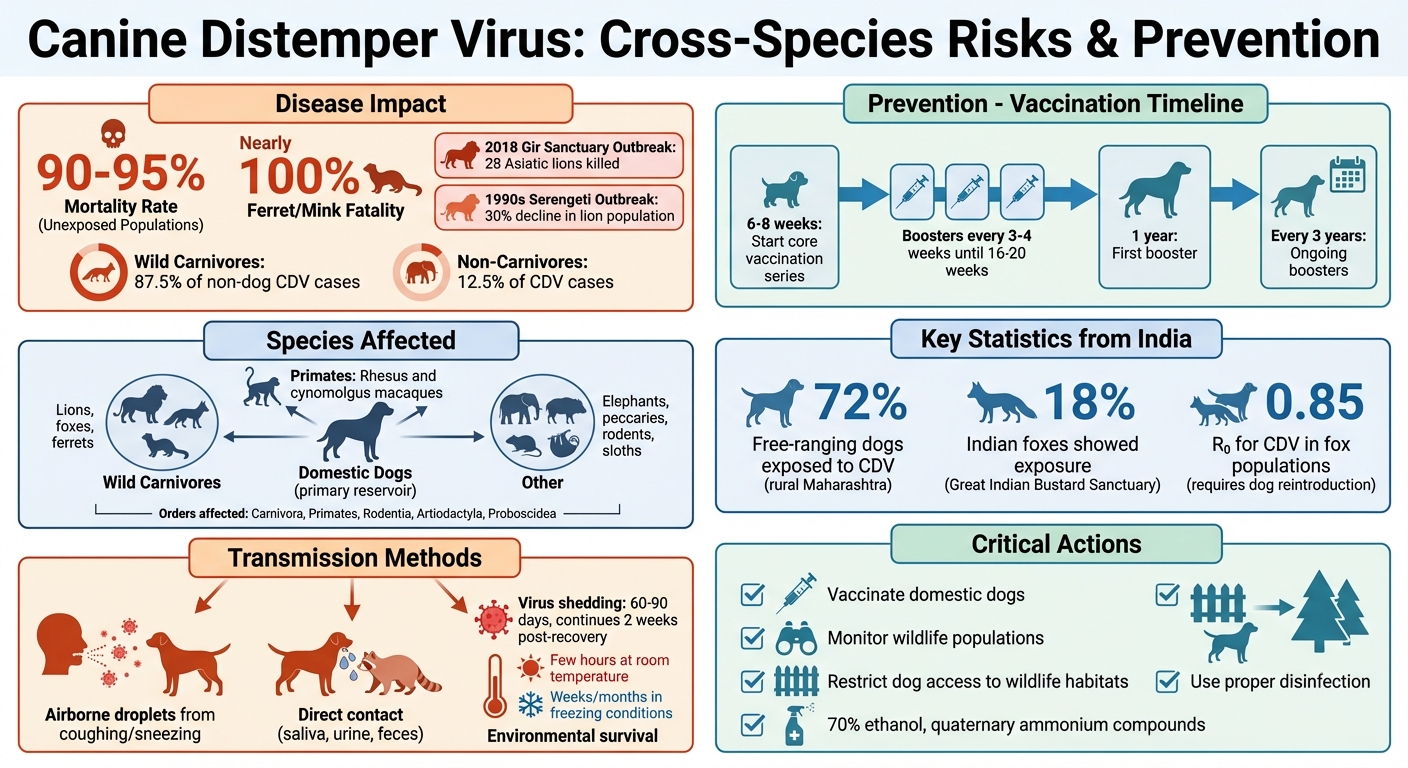
Canine Distemper Virus: Cross-Species Impact and Prevention Statistics
How Canine Distemper Virus Spreads Between Species
Transmission Methods
Canine Distemper Virus (CDV) spreads through several pathways, making it challenging to control. The most common method is airborne transmission. When an infected animal coughs or sneezes, it releases virus-laden droplets into the air, which other animals can inhale. This mode of transmission is particularly concerning in areas with high animal density.
"The major route of CDV transmission is through aerosols from respiratory exudates containing the virus, although other body excretions and secretions (e.g., urine) can be infectious." – BMC Veterinary Research
Direct contact is another significant route. Activities like grooming, fighting, mating, or predation can spread the virus through saliva, urine, faeces, and other bodily secretions. Infected animals can shed the virus for 60–90 days and continue to do so for up to two weeks after recovery. Solitary species often contract CDV by preying on infected domestic or wild carnivores.
The virus's survival outside a host depends on environmental conditions. CDV is sensitive to heat and detergents, remaining active for only a few hours at room temperature. However, in cold conditions, it becomes more resilient, surviving for weeks or even months in freezing temperatures. This explains seasonal trends: domestic dog outbreaks are more common in autumn and winter, while wildlife cases rise in spring and summer, coinciding with the birth of vulnerable juveniles.
Understanding these transmission methods is critical, especially since environmental factors greatly influence the virus's ability to persist and spread.
Environmental and Ecological Factors
Human activities like urbanisation and habitat encroachment have increased interactions between domestic dogs and wildlife, creating more opportunities for CDV to spill over into wild populations. For example, in rural Maharashtra, studies show that over 72% of free-ranging dogs have been exposed to the virus. These large dog populations near protected wildlife areas act as a continuous source of infection.
CDV thrives in high-density populations, where it can maintain an enzootic (persistent) state. In smaller or isolated groups, the virus typically follows a boom-and-bust pattern - causing severe outbreaks before disappearing, only to return when reintroduced. The frequency of spillover events depends heavily on the roaming behaviour of domestic dogs and their proximity to wildlife habitats.
A study at the Great Indian Bustard Wildlife Sanctuary highlighted this issue. Researchers found that 72% of sampled dogs were seropositive for CDV, while 18% of Indian foxes showed exposure. Modelling suggested that vaccinating dogs alone was insufficient to stop spillover because most adult dogs already had antibodies. The real problem was the movement of "roamer" dogs into fox habitats, which drove the spread of the virus.
sbb-itb-5205b1e
Species Affected by Canine Distemper Virus
Wildlife at Risk
Canine Distemper Virus (CDV) is a serious threat to a wide range of wildlife, impacting species from several orders like Carnivora, Rodentia, Primates, Artiodactyla, and Proboscidea. Wild carnivores are particularly susceptible, accounting for 87.5% of non-dog CDV cases, making them a critical group at risk of infection.
In India, CDV has had devastating effects on iconic wildlife. A stark example is the 2018 outbreak in the Gir Wildlife Sanctuary, which highlighted the virus's lethal potential in endangered species. Mortality rates in populations with no prior exposure to the virus can be alarmingly high. For instance, both black-footed ferrets and domestic ferrets face nearly 100% mortality when infected. Similarly, a CDV epidemic in Serengeti National Park during the 1990s caused a 30% decline in the lion population.
This widespread impact on wildlife is closely tied to the role domestic dogs play in perpetuating the virus.
Domestic Dogs as a Disease Reservoir
While wildlife bears the brunt of CDV outbreaks, domestic dogs act as the primary reservoir, sustaining the virus through dense populations and inadequate vaccination rates. In many developing areas, free-ranging and village dogs keep CDV in a persistent state, creating a continuous risk of spillover into wild carnivore populations. The virus spreads through direct contact, respiratory droplets, and even predation on infected dogs. Research on dog–fox interactions in India shows that the basic reproductive number (R₀) for CDV in some fox populations is only 0.85. This suggests the virus would likely disappear without repeated introductions from domestic dogs.
"The free-ranging dog population often poses a threat of CDV transmission to wildlife." – Devendra T. Mourya, Director, ICMR–National Institute of Virology
Interestingly, recent studies indicate that the virus's reservoir dynamics are evolving. In some ecosystems, CDV is now maintained by a "metareservoir", which includes multiple interconnected wildlife species. This shift complicates control efforts, as the virus becomes less reliant on domestic dogs alone for its survival.
Cases in Non-Carnivore Species
Although most CDV cases are found in carnivores, about 12.5% of infections occur in species from other orders, such as Primates, Artiodactyla, Rodentia, Proboscidea, and Pilosa. Among non-human primates, all documented cases have shown clinical symptoms, with lethal outbreaks reported in breeding colonies of rhesus and cynomolgus macaques. This raises concerns about the virus's potential to adapt to species closely related to humans. What adds to this concern is the similarity between human and primate SLAM receptors, which serve as the virus's entry point.
Other unusual hosts include peccaries, elephants, rodents, and sloths. In Artiodactyla, seroprevalence rates have reached 41.7%, while in Proboscidea, the rate is approximately 1.3%. CDV's ability to infect such a wide range of species is tied to its capacity to bind SLAM receptors, with mutations in the Hemagglutinin protein - specifically at residues 530 and 549 - enabling it to jump between species.
"CDV is able to infect a very wide range of host species from many different Orders and emphasises the potential threat of infection for endangered wild species." – BMC Veterinary Research
The ability of CDV to cross traditional species boundaries highlights the challenges in controlling its spread, especially within the complex "metareservoir" of interconnected hosts. This adaptability underscores the urgent need for effective management strategies to protect vulnerable wildlife populations.
Prevention and Management Strategies
Vaccination Protocols
Vaccination is the best defence against canine distemper virus (CDV), especially for domestic dogs. Puppies should start their core vaccination series between 6–8 weeks of age, with boosters every 3–4 weeks until they are 16–20 weeks old. After completing this initial series, a booster is given at one year, followed by vaccinations every three years. For puppies with high maternal antibodies, a measles vaccine at 6–7 weeks can provide temporary immunity, after which CDV vaccines can be administered starting at 12–16 weeks.
"Vaccination is very effective at preventing CDV, and it is a core vaccination for every dog." – Cornell University College of Veterinary Medicine
Vaccination strategies for wildlife are more complex. Modified-live virus (MLV) vaccines, commonly used for domestic dogs, can sometimes cause vaccine-induced illness or death in sensitive species like red pandas and black-footed ferrets. To address this, recombinant canarypox vector vaccines are preferred for ferrets and many zoo animals because they are safer. Studies show that immunity from MLV vaccines in domestic dogs lasts at least three years.
Local conditions also play a role in vaccination planning. A 2015 study at the Great Indian Bustard Wildlife Sanctuary revealed that mass dog vaccinations by the Maharashtra Forest Department were less effective, as many adult dogs already had natural antibodies. The study suggested that directly vaccinating wildlife, such as Indian foxes, or limiting dog movements would better prevent disease spillover.
Robust post-vaccination surveillance ensures early detection and quick action when needed.
Surveillance and Monitoring
After vaccination, thorough surveillance is key to controlling CDV outbreaks. This includes collecting samples like ocular, nasal, and rectal swabs, blood, and even visceral organs (e.g., lungs, liver, kidney) from both live animals and carcasses. Advanced diagnostic tools like reverse transcription PCR (RT-PCR), real-time RT-PCR, and whole-genome sequencing are essential for identifying virus strains and tracking mutations that enable cross-species transmission.
In September 2018, the Indian Council of Medical Research (ICMR) and the National Institute of Virology investigated a CDV outbreak in Gir Wildlife Sanctuary. Led by Dr. Devendra T. Mourya, the team analysed samples from 229 wild and 87 captive Asiatic lions using heminested RT-PCR and next-generation sequencing. They identified CDV in 68 lions and 6 leopards, confirming that the virus was genetically identical across the samples. This data supported efforts to relocate and reintegrate the lion population into different sanctuaries.
Monitoring stray dogs near wildlife habitats is also critical, as their movements significantly influence disease spread. Surveillance should intensify during spring and autumn when CDV cases peak due to juvenile susceptibility and the virus's longer survival in cooler temperatures. Testing for rabies should also be integrated, as neurological symptoms of CDV and rabies are often hard to distinguish.
Effective surveillance data allows for timely containment and outbreak control.
Containment Measures During Outbreaks
When an outbreak is detected, swift containment is crucial. Infected animals must be isolated immediately. While dogs typically shed the virus for about a month, those with neurological symptoms can continue shedding for 6–8 months. Caretakers should wear disposable gowns, gloves, and booties when handling infected animals or cleaning contaminated areas.
CDV is highly sensitive to lipid solvents and disinfectants like phenols and quaternary ammonium compounds, making regular cleaning of kennels and veterinary facilities essential. Removing infected carcasses promptly also helps minimise environmental contamination.
"Canine distemper virus is sensitive to lipid solvents such as ether, as well as most disinfectants, including phenols and quaternary ammonium compounds; these substances should be part of the cleaning and disinfection protocols at kennels and veterinary premises." – Kate E. Creevy, DVM, MS, DACVIM-SAIM, Texas A & M University
Reducing the number of free-ranging domestic dogs and restricting their access to wildlife habitats are critical steps. In areas where domestic dogs and wildlife coexist, sustained interventions - like controlling dog movements in protected areas - are the most effective. For highly endangered species such as the Asiatic lion, relocating or redistributing populations to different sanctuaries can be a long-term conservation strategy to prevent a single outbreak from wiping out the species.
Conclusion
Key Points to Remember
Canine distemper virus (CDV) isn’t limited to dogs - it’s a highly infectious morbillivirus affecting a wide range of mammals, including carnivores and primates. In populations without prior exposure, the disease can cause morbidity and mortality rates as high as 90–95%. For species like ferrets and minks, the virus is almost always fatal. CDV thrives in a complex network of domestic and wild hosts. By vaccinating dogs, pet owners not only safeguard their pets but also help prevent the virus from spilling over into vulnerable wildlife, such as the Asiatic lions in Gir or the island foxes on Santa Catalina. This makes vaccination a crucial step in controlling CDV across species.
"CDV appears to be maintained by a metareservoir rather than a single species, requiring the need to vaccinate the wildlife species at risk." – Rebecca P. Wilkes, Purdue University
Currently, vaccination is the only effective defence against CDV, as no cure exists. Puppies should complete their vaccination series between 6–16 weeks of age, followed by regular booster shots. In India, where over 72% of free-ranging dogs in some rural areas show exposure to CDV, responsible pet care is crucial. This includes keeping dogs from straying into wildlife habitats, which is essential for conservation efforts. Additionally, thorough cleaning with 70% ethanol or quaternary ammonium compounds like benzalkonium chloride is necessary in areas exposed to the virus.
Looking Ahead
These findings underscore the importance of collaborative strategies to combat CDV. Pet owners, veterinarians, and wildlife conservationists must work together to minimise transmission between domestic dogs and wildlife. Authorities should focus on integrated approaches, using ecological models and field studies to pinpoint specific reservoirs and transmission routes. For endangered species, recombinant canarypox-vectored vaccines offer a safer option compared to modified-live virus vaccines, which can be harmful to some wildlife species.
Recent outbreaks in non-human primates, such as rhesus and cynomolgus macaques, have raised alarms about CDV’s potential to become a zoonotic threat, especially as global measles vaccination rates decline. Monitoring genetic strains like India-1/Asia-5 is critical for designing effective diagnostics and vaccines.
Efforts to control CDV go beyond protecting individual animals - they are about preserving ecosystems and safeguarding biodiversity for future generations.
FAQs
How does vaccinating dogs help protect wildlife from Canine Distemper Virus?
Vaccinating domestic dogs is a critical step in managing the spread of Canine Distemper Virus (CDV). It helps establish herd immunity, reducing the presence of the virus among dogs and curbing its transmission to other animals.
Vaccination lowers the likelihood of virus shedding, which in turn minimises the risk of CDV infecting susceptible wildlife like big cats, foxes, and other carnivores. This becomes even more crucial in regions where domestic and wild animals often come into contact.
By keeping your pets vaccinated, you're not just protecting them - you’re also contributing to the preservation of India’s rich biodiversity, shielding it from the harmful impacts of this disease.
How do human activities contribute to the spread of Canine Distemper Virus across species?
Human actions significantly influence the transmission of the Canine Distemper Virus (CDV) between domestic dogs and wildlife. In India, unvaccinated stray dogs often serve as carriers of the virus, posing a serious threat to nearby wildlife, such as Indian foxes. This can result in severe outbreaks that lead to high mortality rates in these vulnerable species.
As cities expand, the interactions between domestic dogs and wildlife in peri-urban areas increase, creating more opportunities for the virus to jump between species. Human-driven changes like deforestation, feeding stray dogs with waste, and relocating them to new areas further heighten the risk by creating more contact points between infected and healthy animals. On top of this, limited public awareness about the importance of vaccinations and the lack of coordinated efforts to manage stray dog populations make the problem even worse.
Encouraging widespread vaccination for domestic dogs and educating people about disease prevention are critical measures to stop this human-driven cycle of transmission. These efforts can help safeguard the health of both pets and wildlife.
Can Canine Distemper Virus affect animals like primates or elephants?
Canine Distemper Virus (CDV) isn’t limited to infecting dogs - it has the ability to affect a wide variety of mammals. Part of the morbillivirus group, this virus can cross species barriers, impacting animals as diverse as primates and even large creatures like elephants. Documented cases include infections in rhesus macaques and other non-carnivorous species, underscoring its extensive host range.
In India, the presence of free-roaming dogs near wildlife reserves adds another layer of concern. These dogs can act as carriers, transmitting CDV to wildlife species that share their habitat. Animals such as Asian elephants and primates are particularly at risk. The virus is known to cause severe respiratory, gastrointestinal, and neurological issues, often leading to high mortality rates. This makes CDV a pressing issue for wildlife conservation, as it threatens the health and survival of vulnerable species.


