


You bought the supplement. You've been giving it every morning, sprinkled into the bowl or hidden inside a treat. Two weeks have gone by. Your dog is still scratching. Still dull-coated. Maybe the skin around the ears still looks a little flaky, or the belly is still pink and irritated. And now you're starting to wonder — did I buy the wrong thing? Is this even doing anything? Do I need to give this forever, or can I eventually stop?
These are exactly the right questions. They're also the ones most packaging refuses to answer — and most people feel awkward asking their vet, because it somehow feels like a silly thing to have spent money on.
Here's what's actually happening: skin supplements, when chosen correctly and used properly, are one of the most effective long-term tools for managing chronic skin issues in dogs. But they work on a different timeline than most pet parents expect. They're not a cream you apply to a rash and watch it clear in three days. They work from the inside out, rebuilding the architecture of your dog's skin barrier, cell by cell. And that process takes time — more time than most people give it.
This guide walks you through everything you need to know to use these supplements intelligently: what Omega-3 fatty acids are actually doing inside your dog's body, how to read a label without getting fooled by marketing numbers, which form of supplement is actually best, what a realistic week-by-week timeline looks like, and most importantly — how you decide whether to keep going, stop, or switch to something else.
How Omega-3 Fatty Acids Support Skin Health
Most pet parents think of Omega-3 fatty acids as something that makes a coat shiny. And they're right — eventually. But the mechanism goes much deeper than a cosmetic result, and understanding it explains why you're going to need to be patient.
Your dog's skin is made up of millions of cells, and each of those cells has a membrane — a thin outer wall that controls what goes in and what stays out. Omega-3 fatty acids, specifically EPA (eicosapentaenoic acid) and DHA (docosahexaenoic acid), become part of those cell membranes. They make the membranes more fluid, more responsive, and better at managing inflammation. When your dog is chronically deficient in these fatty acids — which most dogs on standard commercial kibble are, to some degree — those membranes are stiffer and more prone to inflammatory signalling.
This deficiency is more common in India than many pet parents realise. The majority of commercially available kibble sold in the Indian market uses chicken as the primary protein source, with sunflower or soybean oil as the dominant fat. Both are high in Omega-6 fatty acids. Omega-6 and Omega-3 compete for the same metabolic enzymes, and when Omega-6 significantly dominates the diet — as it typically does in a chicken-heavy kibble with no marine fat source — the outcome is a chronic, low-grade pro-inflammatory state in the skin. This doesn't cause dramatic symptoms on its own, but it lowers the threshold for flares, worsens existing allergic conditions, and contributes to dull, brittle coat over time.
Here's where the timeline comes from: your dog's skin cells don't all get replaced at once. The skin renews itself in cycles. Old cells shed, new cells form. For a supplement to change how your dog's skin behaves, it needs to be present when those new cells are being built. You're not patching existing cells — you're changing the raw materials available for the next generation of cells. That turnover cycle takes approximately six to eight weeks to produce visible results. Sometimes a little faster in younger dogs. Sometimes ten to twelve weeks in older dogs with chronic skin issues.
The inflammatory side of Omega-3 matters equally. EPA, in particular, is a precursor to prostaglandins and leukotrienes — molecules that regulate the body's inflammatory response. In simple terms: EPA gives your dog's immune system the raw material to produce less aggressive inflammatory signals. If your dog has atopic dermatitis (a chronic allergic skin condition), hot spots, or a generally reactive skin, adequate EPA can meaningfully reduce the intensity of those flare-ups over time. Not eliminate them — manage them. That distinction matters.
This is especially relevant in India's climate. High ambient temperature and humidity — particularly during the pre-monsoon and monsoon months — accelerate transepidermal water loss, meaning the skin loses moisture faster than it can retain it. A compromised skin barrier in these conditions is not just itchy; it's an open invitation for secondary bacterial and yeast infections, which then layer on top of whatever underlying allergic condition your dog already has. EPA and DHA directly support the synthesis of ceramides and other lipids that constitute the skin's moisture barrier. Supplementation doesn't just reduce inflammation — it also helps the skin physically hold water, which matters considerably in a climate that works against it.
DHA plays a slightly different role. It's essential for the structural integrity of skin cells and has particularly strong evidence for supporting coat quality — texture, lustre, and reduced shedding. It's also the dominant Omega-3 in the brain, which is why fish oil supplements are sometimes recommended for older dogs with cognitive changes alongside their coat benefits.
The short version: Omega-3 supplementation is rebuilding your dog's biology. Give it the eight weeks it needs before you judge the results.
sbb-itb-5205b1e
How to Read a Label Without Being Fooled
This is where most pet parents go wrong, and it's not their fault — supplement labels are designed to impress, not to inform.
The number that gets printed largest on most fish oil products is "total fish oil" — usually listed in milligrams and often a very big number. 1,000mg. 3,000mg. Sometimes more. That number tells you almost nothing useful. Fish oil is a mixture of many fatty acids and other compounds. The only numbers that matter for your dog's skin are the EPA and DHA content specifically.
Here's what to look for: turn the product over and find the actual supplement facts panel. Look for EPA and DHA listed separately in milligrams per serving. The sum of those two numbers is what you're actually dosing your dog with. A product with 3,000mg of "total fish oil" might only contain 500mg of combined EPA and DHA — because the rest is other fats with no particular skin benefit. Meanwhile, a well-formulated product with 1,000mg total oil might contain 700mg of combined EPA and DHA, which makes it significantly more potent per millilitre.
General veterinary guidance suggests a ballpark of around 30–40mg of combined EPA and DHA per kilogram of your dog's body weight per day for general skin support, and higher amounts for dogs with active inflammatory conditions — but your vet should be the one to confirm the right range for your specific dog, because it depends on their weight, their existing diet, and what you're trying to address. What matters for your label-reading is that you're calculating the dose based on EPA + DHA content, not total fish oil volume.
The other thing to check is the source. EPA and DHA come from marine sources — fish oil, krill oil, or algae oil. If a product lists "plant-based Omega-3" or is primarily flaxseed oil, it contains a different type of Omega-3 called ALA. We'll come back to this in the common mistakes section, because it's one of the biggest misunderstandings in canine nutrition.
Finally, check for a freshness indicator. Fish oil oxidises — it goes rancid — relatively quickly after opening, and this is accelerated in warm environments. In Indian conditions, where room temperatures regularly exceed 30°C for much of the year, a liquid fish oil supplement left on a kitchen counter degrades substantially faster than the label's printed shelf life anticipates. Good products will list an expiry date, recommend refrigerating after opening, and ideally contain a natural antioxidant (like vitamin E or rosemary extract) to extend stability. Rancid fish oil is not just ineffective; it can actually cause oxidative stress in your dog's cells, doing the opposite of what you're trying to achieve. If the oil smells aggressively fishy or sour, it's past its best — store it in the refrigerator from the day you open it, regardless of what the label says.
Liquid vs. Capsules vs. Chewables
The honest answer is: the best form is the one your dog will actually consume consistently. But there are real differences worth understanding.
| Form | Advantages | Drawbacks | Ideal For |
|---|---|---|---|
| Liquid Oil | High potency; adjustable dosing; easy to mix with food | Can oxidise in heat; needs refrigeration | Larger dogs; cost-conscious owners who want precise dosing |
| Capsules (Softgels) | Protects oil from air and light; no mess; odour-free; stable | Fixed doses; some dogs may refuse to swallow | Picky eaters (if hidden in treats); convenient for travel |
| Chewables (Soft Chews) | Tasty and easy to give as treats | Often under-dosed; more expensive per dose | Dogs needing minor maintenance rather than active treatment |
Liquid fish oil is the most flexible option. You control the dose precisely — important for dogs whose weight doesn't match a standard capsule size. It mixes easily into food. Good-quality liquid oils are highly bioavailable, meaning the fatty acids are absorbed efficiently from the digestive tract. The downsides are storage (it needs to be refrigerated and used within four to eight weeks of opening, with particular attention in warm months), the smell (some dogs love it; some owners find it takes getting used to), and the fact that measuring with a dropper adds a step to your routine.
Capsules (soft gels) are convenient and precisely dosed. They're better for travel and don't require refrigeration until opened. The limitation is that standard human-grade capsule sizes may not match your dog's weight-appropriate dose neatly, so you may end up giving multiple capsules or half-doses, which gets messy. Some dogs will eat a capsule mixed into food; others will surgically remove it and leave it on the floor. If you pierce the capsule and squeeze the contents out, you've essentially made your own liquid supplement, though the dose per capsule may be smaller than what you'd pour from a bottle.
Chewable supplements (often called Omega-3 chews or skin and coat chews) are the most palatable for fussy dogs and the easiest to administer. They often contain additional ingredients alongside the Omega-3 — biotin, zinc, vitamin E, and sometimes ingredients like evening primrose oil for gamma-linolenic acid (GLA), which complements EPA and DHA in managing skin inflammation. The important thing to check is whether the chew form actually contains meaningful EPA and DHA levels, because many chews are calorie-dense and the active ingredient content can be diluted. Some chews marketed for "skin and coat" rely heavily on biotin and zinc alone, with minimal actual Omega-3. Read the EPA + DHA numbers, not just the marketing claim on the front.
Don't give your Pets Fish Oil UNLESS you are doing these 5 Things
The Real Timeline — Week by Week
This is the section most supplement guides skip, because it requires honesty about the fact that results take longer than customers expect. But knowing the real timeline is what keeps you from giving up three weeks before the supplement actually starts working.
Weeks 1–2: Nothing visible, but something is happening. The fatty acids are being absorbed and beginning to incorporate into cell membranes. You likely won't see any change in your dog's coat or skin. If your dog has very dry, flaky skin, you might notice a very slight reduction in flakiness — but don't count on it this early. What you can do at this stage is establish your baseline: take a photo of your dog's coat, note the areas where their skin looks most irritated, and keep a simple log of how often they're scratching each day. You'll want this comparison point in six weeks.
Weeks 3–4: Early signals, if they're coming. Some dogs — particularly younger ones or those with moderate (not severe) skin issues — begin to show early coat improvement around this point. The fur may start to feel slightly softer or less brittle. Scratching frequency might begin to edge down, though this can be inconsistent. Dogs with more entrenched skin issues often show nothing visible yet. This is the week when a lot of pet parents start to doubt the supplement. Don't stop here.
One thing worth noting: if you've started supplementation just before or during the monsoon months, external environmental factors can mask early progress. High humidity during the monsoon increases both fungal skin colonisation and the concentration of dust mite allergens indoors — both of which drive itching through mechanisms entirely separate from Omega-3 deficiency. If your dog's scratching is unchanged or worsening at week three during this period, it may reflect the seasonal environmental load rather than a failure of the supplement.
Weeks 5–6: The window of real change. This is where you should start seeing meaningful differences if the supplement is working. Coat quality improvement — more sheen, less shedding, better texture — is typically evident by week six. Inflammatory skin conditions should show a reduction in redness and intensity of itching. If your dog has recurring hot spots that are triggered by allergies, you may notice either fewer flares or milder ones. Go back to your baseline photos and notes now. The change is often more visible in photographs than it is when you're looking at your dog every day.
Weeks 7–8: Assessment point. By the end of week eight, you have a real answer. If you've seen clear improvement in coat quality, reduced itching, or calmer skin — the supplement is working, and the question now shifts to maintenance. If you've seen essentially no change across eight full weeks of consistent daily supplementation at the correct dose, it's time to reassess. This doesn't necessarily mean Omega-3 supplementation doesn't help your dog — it might mean the dose is wrong, the product quality is poor, or there's an underlying issue (a food allergy, a fungal skin infection, a hormonal problem) that needs a vet's attention. More on that shortly.
Weeks 9–12: Peak and plateau. For most dogs, improvement continues through weeks nine to twelve before levelling off. This plateau is normal — it's the new baseline that consistent supplementation maintains. Coat quality won't keep improving indefinitely; at some point it reaches its optimal state for that dog.
How Much to Give and When to Expect Results
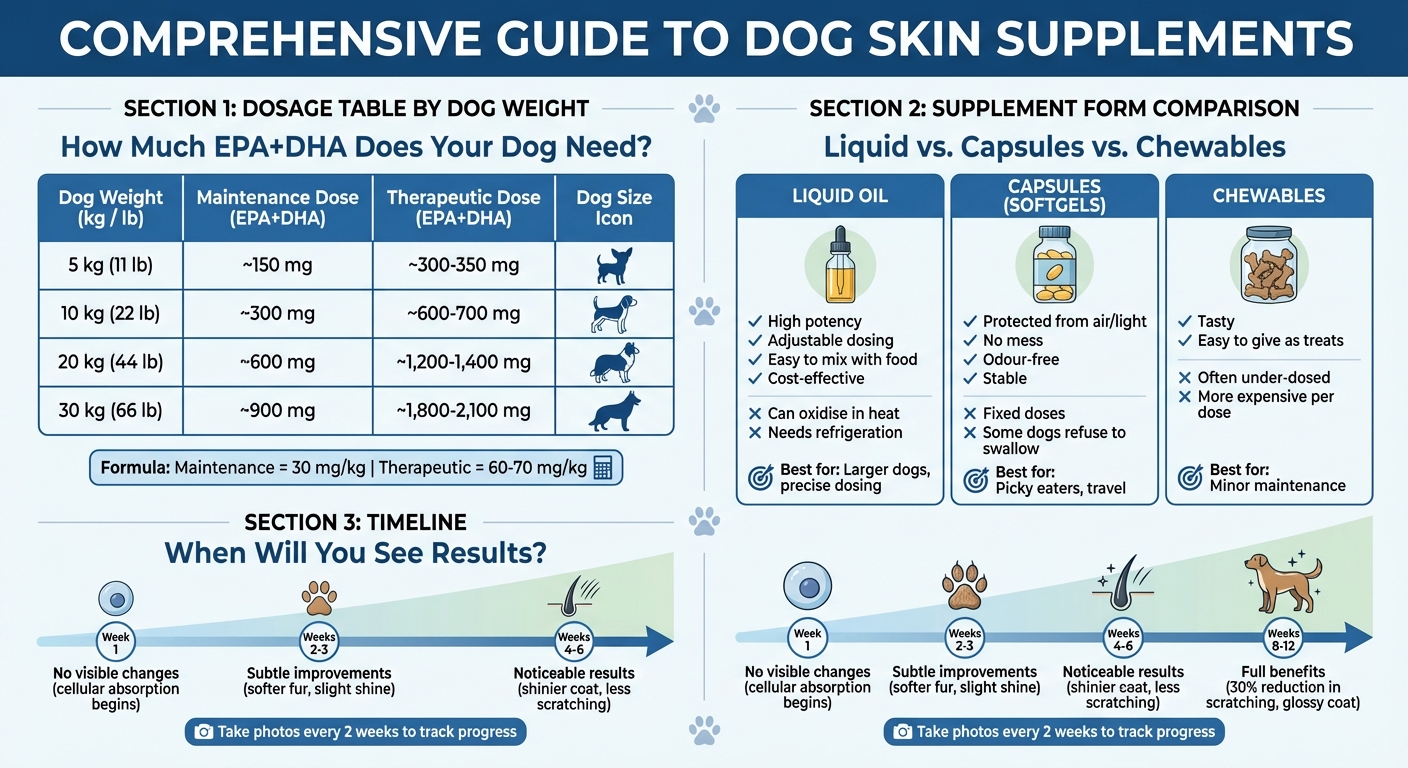
Dog Omega-3 Dosage Guide by Weight and Supplement Form Comparison
The Question Everyone Has But Won't Ask the Vet: Do I Need to Give This Forever?
Here's the truth that should be on every bottle but rarely is: it depends on why you're giving it.
If you're giving it for a chronic condition — atopic dermatitis, seasonal allergies, a persistently itchy or flaky skin type — then yes, long-term or continuous supplementation is usually the answer. The reason is that the benefit depends on the presence of EPA and DHA in your dog's cell membranes. If you stop supplementing, those levels gradually fall back over the following weeks, and the skin issues tend to return. You're not curing the underlying condition; you're giving your dog's immune system better tools to manage it. Those tools disappear when the supply stops.
In a country with year-round environmental allergen exposure — including airborne particulate matter in cities like Delhi and Mumbai, where PM2.5 levels frequently exceed safe thresholds, and the persistent humidity of coastal cities like Chennai and Kochi that sustains mould spore and dust mite populations — atopic dogs rarely have a true "off season." The allergen burden fluctuates but rarely disappears. This is one reason vets experienced in Indian dermatology tend to recommend continuous supplementation rather than seasonal cycling for dogs with confirmed atopic disease.
Priya's Labrador in Hyderabad is a good example of what happens when this isn't understood. Her dog, a four-year-old female named Sasha, had been dealing with chronic ear inflammation and belly itching for most of her life. After a vet consultation confirmed atopic dermatitis, Priya started a high-quality EPA/DHA liquid supplement and saw remarkable improvement by week eight — the ear flares nearly stopped, the belly redness faded significantly. At twelve weeks, feeling like the problem was solved, she stopped the supplement. By week eighteen, Sasha was back to scratching constantly. What Priya took as a cure was actually an ongoing management system she'd inadvertently switched off.
If you're giving Omega-3 as a general nutritional boost — for a healthy dog whose diet may be slightly Omega-3 deficient, or for coat quality in a dog that doesn't have a chronic condition — the calculus is different. Many pet parents in this situation choose to give supplements seasonally or continue indefinitely at a lower maintenance dose. Some dogs do well being cycled on and off — twelve weeks on, a break of four to six weeks, then back on — though continuous supplementation at a correct dose is generally preferred if you're managing active skin issues.
The question to ask your vet at your next appointment is exactly this: "Given what's going on with my dog's skin, should this supplement be permanent or can we trial stopping it after a period?" Most vets will have a clear view based on your dog's history and diagnosis. That conversation is worth having — it takes two minutes and removes all guesswork.pancreatitis.
| Dog Weight | Maintenance Dose (EPA+DHA) | Therapeutic Dose (EPA+DHA) |
|---|---|---|
| 5 kg (11 lb) | ~150 mg | ~300–350 mg |
| 10 kg (22 lb) | ~300 mg | ~600–700 mg |
| 20 kg (44 lb) | ~600 mg | ~1,200–1,400 mg |
| 30 kg (66 lb) | ~900 mg | ~1,800–2,100 mg |
The Common Mistakes That Guarantee It Won't Work
These are the errors that account for most cases where pet parents try Omega-3 supplementation and walk away thinking it doesn't work. In most cases, it wasn't the supplement that failed — it was the approach.
Stopping Too Early
This is the most common mistake, and it explains a significant portion of the "I tried fish oil and it did nothing" experiences that circulate in online groups and WhatsApp communities. Six weeks is the minimum meaningful evaluation window. Most people stop at two to three weeks because they see no visible change and conclude it's not working. Given the biology — the skin cell renewal cycle, the gradual incorporation of fatty acids into membranes — two weeks is too early to see anything definitive. The decision to stop should happen at eight weeks, with consistent daily dosing, at the correct amount. Not before.
Wrong Dosage for Your Dog's Weight
This one is trickier because packages often have dosing guidance that's either too vague ("small, medium, large dogs") or calibrated to the total oil volume rather than EPA + DHA content. A 30kg dog given the dose labelled for a "large dog" on a product with low EPA/DHA concentration might be getting a fraction of what they actually need. The dose that makes a meaningful difference is based on your dog's weight and the concentration of active fatty acids — which is why calculating from the supplement facts panel (EPA + DHA in mg per serving) matters more than following the general size guidance on the front.
Rohit had a 28kg Indie dog in Bengaluru named Bruno who'd been given a chewable supplement for four months with minimal improvement. When he brought Bruno to the vet to discuss the lack of progress, they calculated his actual EPA + DHA intake and found he was receiving less than a third of what would be therapeutic for a dog his size. The issue wasn't the supplement itself — it was that the product's serving guidance hadn't been adjusted for Bruno's actual weight within the "large dog" category. Increasing to the correct amount produced visible results within six weeks.
Giving Flaxseed Oil Instead of Fish Oil
This is the mistake that most articles don't talk about, and it's a significant one. Flaxseed oil contains Omega-3 fatty acids — specifically ALA (alpha-linolenic acid) — and is marketed as a plant-based alternative to fish oil. The problem is that dogs cannot efficiently convert ALA into EPA and DHA. The conversion pathway exists in theory, but the conversion rate in dogs is very low — some estimates put it below 5% for EPA and even less for DHA.
This means that a dog given flaxseed oil as their Omega-3 supplement is receiving the wrong form of the fatty acid. ALA doesn't incorporate into cell membranes and regulate inflammation the same way EPA and DHA do. It's not that flaxseed oil is harmful — it's that it doesn't produce the skin and coat benefits that fish oil does. If your supplement is described as "plant-based" or lists flaxseed, hemp seed, or canola as its primary Omega-3 source, that's why you may not be seeing results.
The only plant-based Omega-3 that provides EPA and DHA directly is algae oil — because marine algae are actually the original source of these fatty acids in the ocean food chain (fish accumulate EPA and DHA by eating algae, directly or indirectly). Algae-based supplements are a genuinely useful option for dogs whose owners prefer to avoid fish-derived products, and they provide the active forms of the fatty acid without the conversion problem.
Giving It Inconsistently
Omega-3 supplementation works on consistent daily dosing. Missing three days, giving double on the fourth to compensate, skipping weekends — this disrupts the steady state of fatty acids in the blood and cell membranes. The supplement works cumulatively. Treat it like a daily medication: same time, same dose, every day. Festive seasons are a common disruption point — routine changes around Diwali, Holi, or extended family visits mean feeding schedules shift, and supplements are often the first thing that gets forgotten. If you're finding it hard to maintain consistency, link the supplement dose to something fixed in your own routine rather than depending on memory.
Relying on Home Remedies Instead of or Alongside Supplementation
This deserves direct discussion because it's common and well-intentioned. Turmeric paste applied to irritated skin, coconut oil rubbed into a dry coat, or curd given orally as a probiotic — these are remedies that circulate widely in pet owner communities, and some have a reasonable basis in general wellness. But none of them addresses the Omega-3 deficiency that underlies most diet-related skin problems in Indian dogs.
Topical coconut oil, in particular, can be actively counterproductive on skin that is already inflamed or has an active yeast component. Malassezia — a yeast that thrives in warm, humid environments and is extremely common in Indian dogs, particularly in coastal cities and during monsoon months — feeds on fatty acids. Applying saturated fat topically to already-colonised skin can worsen the infection while appearing to provide temporary surface relief. If your dog's skin looks greasy or smells musty, do not apply oil topically without a vet's assessment first.
Oral turmeric has some legitimate anti-inflammatory chemistry in its active compound curcumin, but its bioavailability in dogs is low without specific formulation, and the concentrations present in home preparations are far below anything clinically meaningful. It is not a substitute for EPA/DHA supplementation in a dog with structural Omega-3 deficiency.
These remedies are not the problem in themselves. The problem is when they replace, or delay, supplementation and veterinary assessment that would actually resolve the underlying issue.
Ignoring Underlying Conditions
Omega-3 supplementation can dramatically improve skin health, but it cannot fix everything. A dog with a food allergy whose trigger protein is still in their diet will continue to react regardless of how good their Omega-3 levels are. In India, where many dogs are fed home-cooked meals alongside or instead of commercial food — commonly roti with ghee, or rice with chicken — identifying and eliminating a dietary allergen is more complicated than simply switching kibble brands. Ghee is a concentrated source of saturated fat with minimal Omega-3 content; it does not worsen skin directly, but it adds to an already Omega-6-heavy dietary profile. Wheat, present in roti, is a recognised allergen in some dogs and can drive skin and gastrointestinal symptoms that no supplement will resolve without a proper elimination trial.
A dog with a hypothyroid condition — where inadequate thyroid hormone causes dry, brittle coat and skin issues — needs thyroid support, not just fatty acids. A dog with a secondary bacterial or yeast skin infection (pyoderma or Malassezia overgrowth) needs appropriate antimicrobial treatment alongside any nutritional support.
If you've been consistent at the right dose for eight full weeks and seen minimal improvement, this is the signal to see your vet — not to try a different brand. Persistent skin issues that don't respond to good supplementation often have an underlying cause that needs diagnosis and targeted treatment. That diagnosis changes everything, and no supplement article can replace it.
How to Know If It's Working vs. Time to Try Something Different
At the eight-week mark, you need to make one of three assessments. Here's how to think through each one honestly.
Assessment 1: It's working — keep going
The signs that a supplement is genuinely working are specific, not just a feeling. You should see at least two or three of the following: visibly improved coat texture (softer, shinier, less brittle), reduced shedding, less frequent scratching (ideally trackable against your week one baseline notes), calmer skin appearance (less redness, less flakiness, less irritation around the typical hot spots), and fewer or milder flare-ups of whatever condition prompted you to start in the first place. If you're seeing this, the supplement is working. Continue at the same dose.
Assessment 2: Partial improvement — adjust before changing
If you're seeing some improvement but it feels modest or incomplete, don't immediately switch products. First, recalculate your dose against your dog's weight and the actual EPA + DHA content on the label — under-dosing is very common and easy to miss. Second, consider whether a multi-nutrient skin supplement might add benefit — a formula that combines EPA/DHA with zinc, biotin, and GLA (from sources like evening primrose or borage oil) can sometimes produce better results than Omega-3 alone, particularly for dogs with chronically dry, flaky skin or brittle coat. Give the adjusted approach another six to eight weeks before evaluating again.
It's also worth considering whether a seasonal trigger might be suppressing the improvement. Dogs in North Indian cities often experience a significant worsening of atopic symptoms in October and November — the combination of post-monsoon humidity, Diwali-related air pollution, and the stress response to firework exposure (which elevates cortisol and can directly suppress immune regulation) creates a compound challenge. If your dog's eight-week mark falls within this window, a partial response may not reflect the supplement's true efficacy. Discuss the timing with your vet before concluding the approach isn't working.
Assessment 3: No meaningful change — see your vet
If eight weeks of consistent, correctly dosed supplementation has produced essentially no visible change, that's information — and it's pointing you toward an underlying problem that needs a vet's eyes. Bring your supplement, your dosing log, and your baseline photos. A vet can check for hypothyroidism (a blood test), assess the skin directly for secondary infection, discuss food elimination trials if allergies are suspected, and recommend prescription-strength approaches — including fatty acid formulations designed for clinical dermatology use, which are significantly more concentrated than retail products.
This isn't a failure. It's the smarter next step. One of the most common patterns vets see is dogs who've been given supplements for months without a diagnosis, when the underlying issue needed targeted treatment all along. Getting to that diagnosis six weeks earlier means your dog gets relief sooner.
Other Skin Supplement Ingredients Worth Knowing
While Omega-3 is the centrepiece of most skin supplement protocols, there are several other ingredients you'll see on labels that have genuine evidence behind them — and some that are more marketing than medicine.
Zinc plays a direct role in skin barrier function and wound healing. Some dog breeds — particularly Nordic breeds like Siberian Huskies and Alaskan Malamutes — have a genetic tendency to poorly absorb zinc, leading to a condition called zinc-responsive dermatosis with characteristic crusty, scaly skin around the face and paws. For these dogs, zinc supplementation can be genuinely transformative. For other dogs, zinc in combination with Omega-3 supports the anti-inflammatory effect and helps the skin barrier maintain integrity.
Biotin (vitamin B7) is often included in skin and coat supplements and is heavily featured in their marketing. Its role in coat quality is real but modest. Biotin deficiency does cause skin and coat changes, but true deficiency is rare in dogs fed commercial diets. Biotin supplementation in a non-deficient dog adds little measurable benefit to coat quality. That said, it's safe at supplemental levels, so its presence in a multi-nutrient formula isn't harmful — just don't let a high biotin claim substitute for real EPA + DHA content.
GLA (gamma-linolenic acid) from evening primrose oil or borage oil is an Omega-6 fatty acid that has a specific anti-inflammatory role distinct from Omega-3. In dogs with atopic skin conditions, GLA and EPA/DHA work through complementary pathways and can be more effective together than either alone. If your dog has chronically inflamed, itchy skin and standard Omega-3 supplementation has provided only partial relief, a product combining both GLA and EPA/DHA is worth discussing with your vet.
Vitamin E in skin supplements primarily serves as an antioxidant to protect the Omega-3 fatty acids in the product from oxidising — a function that is particularly relevant in hot climates where storage temperature accelerates this process. It also has independent skin benefits — supporting the function of the skin barrier and contributing to anti-inflammatory pathways. Its presence in a supplement formula is a positive sign for both product quality and skin health.
A Note on Diet vs. Supplementation
If your dog is on a fresh food or raw diet with significant fish content — particularly oily fish like rohu, sardines, or mackerel, which are widely available across India and are excellent natural sources of EPA and DHA — their Omega-3 baseline is higher than a dog eating standard dry kibble. Standard commercial kibble tends to be high in Omega-6 fatty acids (from chicken fat and vegetable oils) and relatively low in Omega-3. This Omega-6 to Omega-3 imbalance is pro-inflammatory over time — Omega-6 and Omega-3 compete for the same metabolic pathways, and when Omega-6 dominates, the outcome tilts toward more inflammatory signalling in the skin.
Dogs in Indian households that receive significant home-cooked food alongside their kibble — rice with chicken, chapati with dal, or generous amounts of ghee — are rarely Omega-3 sufficient on diet alone. Ghee and most vegetable cooking oils are composed almost entirely of saturated and Omega-6 fats. They don't worsen skin acutely, but they don't provide EPA or DHA, and they contribute to the imbalance. If your dog regularly receives home-cooked food as a substantial portion of their diet, supplementing Omega-3 is particularly warranted.
Supplementing Omega-3 directly shifts the fatty acid ratio. Some premium kibble manufacturers add fish oil to their formulas, but the amount is rarely sufficient to achieve therapeutic levels for a dog with active skin issues — and heat processing during kibble manufacture degrades the fatty acids. Supplementation on top of even a high-quality commercial diet is generally warranted for dogs with chronic skin concerns.
What to Do Right Now
If your dog is dealing with skin issues and you're considering or already using skin supplements, here's the sequence that makes sense.
First, take a baseline photo today and note the three most visible signs of your dog's skin issue — the specific locations, the frequency of scratching, the appearance of the coat. Date it. You'll need this for comparison.
Second, check your current supplement label. Find the EPA + DHA content per serving in milligrams. If those numbers aren't listed separately — if you can only find "total fish oil" — you need a better product. If the Omega-3 source is flaxseed or hemp, switch to a fish-based or algae-based source.
Third, calculate whether your dose matches your dog's weight and the EPA + DHA concentration of your product. If you're unsure what the right range is, bring the product to your next vet visit and ask them to check.
Fourth, store the supplement correctly. If it's a liquid oil, refrigerate it immediately after opening, regardless of the label instructions — Indian ambient temperatures accelerate oxidation significantly. If it smells rancid, replace it before continuing.
Fifth, commit to eight weeks of consistent daily supplementation — same dose, same time, every day. Set a calendar reminder for week six to do a mid-point review with your baseline photo, and another for week eight to make your final assessment. Do not let festive season routine changes break the streak; consistency over the full period is what produces results.
Sixth, if you reach week eight with no meaningful change, book a vet appointment specifically to discuss your dog's skin. Bring your supplement, your photos, and your dosing notes. Ask about underlying causes — thyroid function, food allergies, secondary infections — rather than simply trying a different brand.
Finally, if it's working at week eight, ask your vet the one question most people skip: should this be permanent or can we eventually trial reducing or stopping? The answer depends on your dog's specific situation, and your vet is the right person to give it.
Skin supplements are genuinely powerful tools when used correctly. The mistakes — stopping too early, wrong dose, wrong form, incorrect storage — are all fixable. And when the right supplement at the right dose runs for the right length of time, the results are often significant. Your dog's skin is worth the eight weeks of patience it takes to find out.
FAQs
How do I calculate EPA+DHA from my fish oil label?
To figure out the EPA+DHA content, look at the product label for the amounts of EPA and DHA listed individually in milligrams per serving. Simply add these two numbers together to find the total EPA+DHA content. It's important to prioritise this combined value instead of the 'total fish oil' amount, as EPA and DHA are the key components that contribute to improving your dog's skin health.
Can Omega-3 supplements clash with my dog’s medicines?
Omega-3 supplements are generally safe and don't usually interact with most medications for dogs. However, if your dog is taking blood-thinning medication, it's important to consult your veterinarian. Omega-3s can have a mild blood-thinning effect, which might require extra caution. Always speak to your vet before introducing any new supplement, especially if your dog has existing health issues or is on multiple medications.
What side effects mean I should stop Omega-3?
If your dog shows symptoms like vomiting, diarrhoea, bad breath, changes in coat colour, weight gain, itchy skin, or signs of hypervitaminosis D after starting omega-3 supplements, stop giving them immediately. These problems could result from high doses or an adverse reaction. Always consult your vet if you notice any of these signs.


